
Blog, Gemstone Guides
Coral in Fine Jewelry: Meaning, Types & Care

Key Takeaways: Coral Jewelry Meaning, Types, and Care
- Coral jewelry meaning has been consistent for two thousand years: protection. The association runs from Roman infant amulets through Renaissance portraiture to the Victorian nursery, and it is a documented cultural tradition rather than a proven property.
- Coral is an organic gem, not a mineral. The material used in jewelry is the hard calcium carbonate skeleton secreted by colonies of marine polyps, colored by carotenoid pigments rather than by trace metals as most mineral gemstones are.
- The gem coral of fine jewelry is not reef coral. Precious coral belongs to the family Coralliidae and grows in cold, dark, deep water — generally between 80 and 2,000 meters depending on species — not on the shallow tropical reefs affected by bleaching, according to Gem-A.
- Coral is not a birthstone. It appears nowhere on the modern list maintained by Jewelers of America, for any month, official or alternate.
- At Mohs 3 to 4 with poor toughness, coral is one of the softest materials regularly set in fine jewelry. It also dissolves in acid, which rules out most household cleaning products and every ultrasonic bath.
What Is the Meaning of Coral Jewelry?
Coral jewelry meaning centers on protection, and it has done so for more than two thousand years. Roman families tied coral branches to infants as a guard against harm, Renaissance painters placed coral around the necks of children, and Victorian jewelers made it a talisman against misfortune. These are documented cultural traditions rather than proven properties, and coral holds no official birthstone status.
Coral at a Glance
| Property | Detail |
|---|---|
| Classification | Organic gem — the calcium carbonate skeleton of colonial marine invertebrates, not a mineral crystallized in rock |
| Gem species | Precious coral of the family Coralliidae, across three genera: Corallium, Pleurocorallium, and Hemicorallium |
| Cause of color | Carotenoid pigments distributed through the calcium carbonate skeleton, producing white, pink, orange, and red |
| Mohs hardness | 3–4 — softer than window glass, and softer than the dust that settles on a dressing table |
| Toughness | Poor — branch structures carry internal growth channels and fissures that can propagate under impact |
| Chemical sensitivity | High. Calcium carbonate reacts with acid, so perfume, vinegar, citrus, and many household cleaners will etch the polish |
| Birthstone | None. Coral is not listed for any month, official or alternate, by Jewelers of America |
| Routinely treated? | Frequently. Dyeing, bleaching, wax impregnation, and polymer stabilization are all in commercial use, and reconstituted material is sold as coral |
| Best settings | Bezel settings and protected mountings. Earrings, brooches, and pendants are better suited than rings worn daily |
| Cleaning | A soft, damp cloth only. No ultrasonic cleaner, no steam, no soaking, no chemical jewelry dip |
What Does Coral Symbolize?
Where Coral Jewelry Meaning Comes From
Coral’s symbolism is unusually consistent across cultures and centuries, and unusually well documented. Its oldest recorded meaning is protective, and the classical world explained that protection through myth: in Ovid’s Metamorphoses, coral forms when Perseus lays the severed head of Medusa on seaweed at the water’s edge, and the plants harden into red stone. A material born from a monster-slaying was, by that logic, a natural guard against harm.
Pliny the Elder recorded the practical consequence in the first century. Roman families fastened branches of coral to infants as amulets, a custom that survived essentially unbroken into the Italian cornicello and into Renaissance painting, where a coral bead or branch hung at a child’s neck is a recognized visual convention. The same protective logic carried coral east: as the GIA records, Mediterranean coral was traded in quantity to China and India during the first millennium precisely because it was believed to hold religious, mystical, and curative powers.
- Protection and safe passage. The dominant traditional association, from Roman amulets through medieval and Renaissance Europe to the Victorian nursery, where coral teething rings and baby bracelets were standard gifts.
- Vitality and life force. Red coral’s color, and the fact that it grows, gave rise to associations with blood, health, and living energy in several traditions. These are cultural beliefs, offered here as such, and not medical claims.
- Calm water and good fortune. Ancient Roman belief held that coral quieted the sea, according to GIA — a meaning that later attached itself to travelers and sailors.
What distinguishes coral jewelry meaning from the symbolism attached to many other stones is that it was not invented recently to sell them. The protective association is attested in Roman literature, visible in fifteenth-century paintings, and documented in Victorian jewelry catalogs. That is a genuine, traceable tradition rather than a modern crystal-lore attribution, and we present it as tradition rather than as fact about what coral can do for anyone’s health or fortune.
Is Coral a Birthstone?
No. Coral does not appear on the modern birthstone list maintained by Jewelers of America — not as an official stone for any of the twelve months, and not among the alternates added in 1952, 2002, or 2016. This places coral alongside morganite, onyx, and rose quartz: gems with a substantial place in jewelry history and a real market presence, but no assigned month on the list that American jewelers standardized in 1912.
Two adjacent traditions are frequently mistaken for birthstone status, and both attach themselves to coral jewelry meaning in ways worth separating clearly. Coral is widely cited as the material associated with the thirty-fifth wedding anniversary, a commercial convention that circulates through anniversary gift lists rather than a designation from any single standards body. Coral also appears in various zodiac and regional astrological systems, most prominently in South Asian practice, where red coral carries a planetary association. Neither system is the calendar-month birthstone list, and neither confers official birthstone status.
The distinction matters commercially as well as factually. A buyer searching for a birthstone gift is working from a fixed twelve-month list; a buyer drawn to coral is choosing it for its color, its history, or its place in a particular design tradition. We would rather state plainly that coral has no month than imply one that does not exist.
What Are the Main Types of Coral Used in Jewelry?
Anyone reading about coral jewelry meaning should also know what the material in the setting actually is, because the word “coral” at retail covers at least three materially different things, and the price difference between them is enormous. The CIBJO Precious Coral Guide draws the line clearly: precious corals are those “used in jewellery and decoration, specifically red, pink and white varieties with porcelain like lustre after polishing,” and they belong to the family Coralliidae across the genera Corallium, Pleurocorallium, and Hemicorallium. Common corals — bamboo, sponge, black, and blue — are, in CIBJO’s words, “only rarely found in jewellery,” and when they are used they have typically been bleached, dyed, or impregnated with polymer first.
| Material | Scientific identity | Typical appearance | What a buyer should know |
|---|---|---|---|
| Mediterranean precious coral | Corallium rubrum | Deep red through classic red to pale pink; dense, waxy to porcelain-like polish | The historic standard of fine jewelry coral, worked at Torre del Greco near Naples for roughly three centuries |
| Aka coral | Corallium japonicum | Intense oxblood red, occasionally translucent | Japanese deep-water species, among the most valuable |
| Momo coral | Pleurocorallium elatius | Orange through salmon to peach-pink | Larger branches than Aka, so it suits carving and substantial beads |
| Shiro and “angel skin” | Pleurocorallium konojoi and related species | White through the delicate pale pink known in the trade as angel skin | Angel skin is a color description, not a species. Even, unblotched pink commands a premium |
| Bamboo and sponge coral | Common corals, outside Coralliidae | Red or orange, often with visible porosity or a jointed structure | Porous material, essentially always dyed and frequently resin-stabilized. Sold legitimately, but it is not precious coral and should never be priced as such |
| Black and blue coral | Antipatharia; Helioporidae | Lustrous black horn-like material; opaque blue-gray | Neither is precious coral of the family Coralliidae. Black coral is occasionally used in jewelry and blue coral only rarely; ask for documented provenance before purchase |
| Reconstituted and imitation | Not coral, or coral fragments plus adhesive | Uniform, saturated color; sometimes suspiciously flawless | GIA lists glass, plastics, dyed limestone, ceramic, bone, and marble as coral imitations, and describes reconstructed coral as fragments glued together and dyed |
Color and evenness drive value within precious coral, with deep, saturated red and unblotched angel-skin pink at the top of the market. Because the material is worked as cabochons, beads, and carvings rather than faceted, the quality of the carving and the polish carries as much weight as it does in any faceted stone.
How Durable Is Coral for Everyday Wear?
Two properties determine whether a gem survives daily life, and they are not interchangeable:
- Hardness (the Mohs scale) is resistance to scratching.
- Toughness is resistance to chipping, cracking, and breaking.
Durability is the part of coral jewelry meaning that romance tends to leave out. Coral rates 3 to 4 on the Mohs scale with poor toughness — the least durable combination of any material we set. To put the number in practical terms, ordinary household dust contains quartz at Mohs 7, which means a coral surface can be abraded simply by being wiped with a dry, dusty cloth. Coral also has a third vulnerability that hardness and toughness do not capture: it is calcium carbonate, and calcium carbonate reacts with acid. Perfume, hairspray, lemon juice, vinegar, and a great many household cleaners will etch a polished coral surface, dulling it permanently.
| Tier | Stones | Mohs | Practical guidance |
|---|---|---|---|
| Daily wear, worry-free | Diamond, ruby, sapphire | 9–10 | Any setting, including open prong |
| Daily wear, sensible care | Aquamarine, morganite | 7.5–8 | Prong, halo, or bezel are all suitable; avoid deliberate impact |
| Occasional to regular wear | Onyx, garnet, peridot | 6.5–7.5 | Bezel recommended for rings worn daily; prong is fine for earrings and pendants |
| Protective settings only | Opal, pearl, coral | Below 6.5, or soft and brittle | Bezel or halo; prefer earrings, brooches, and pendants over rings worn every day |
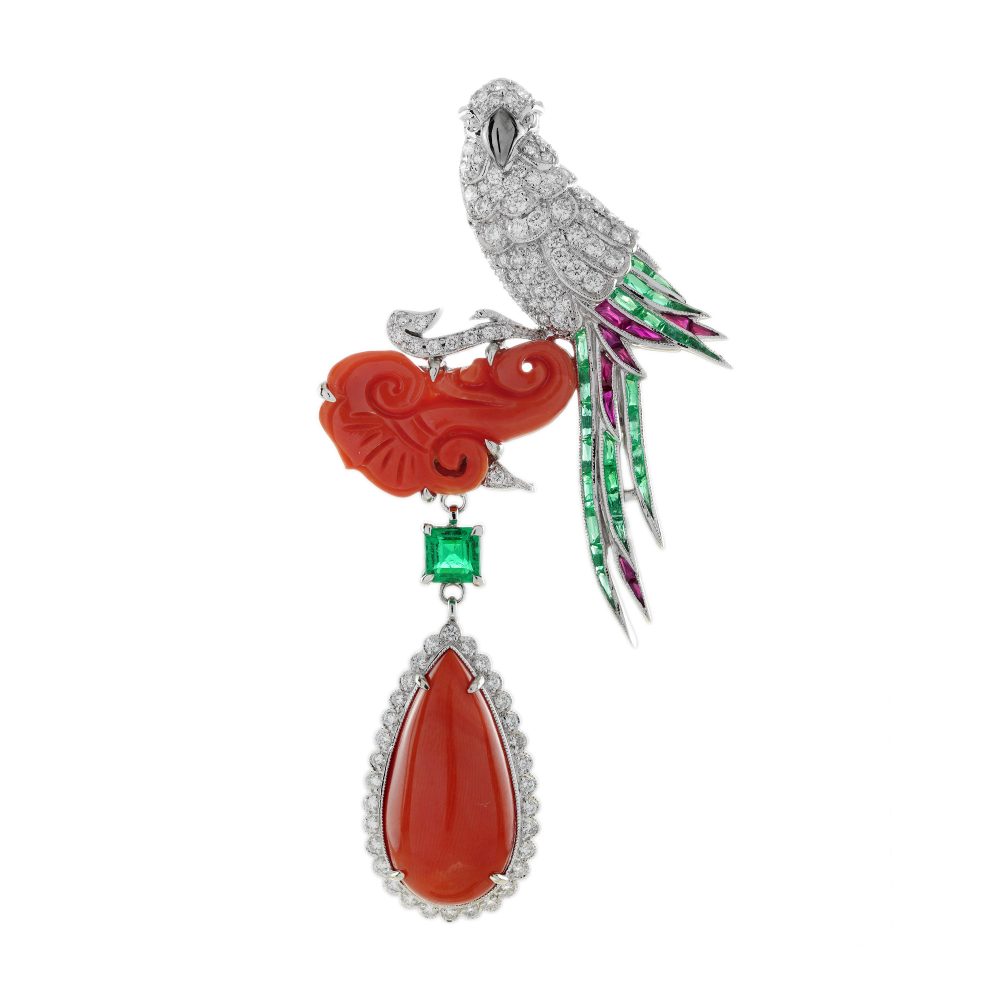
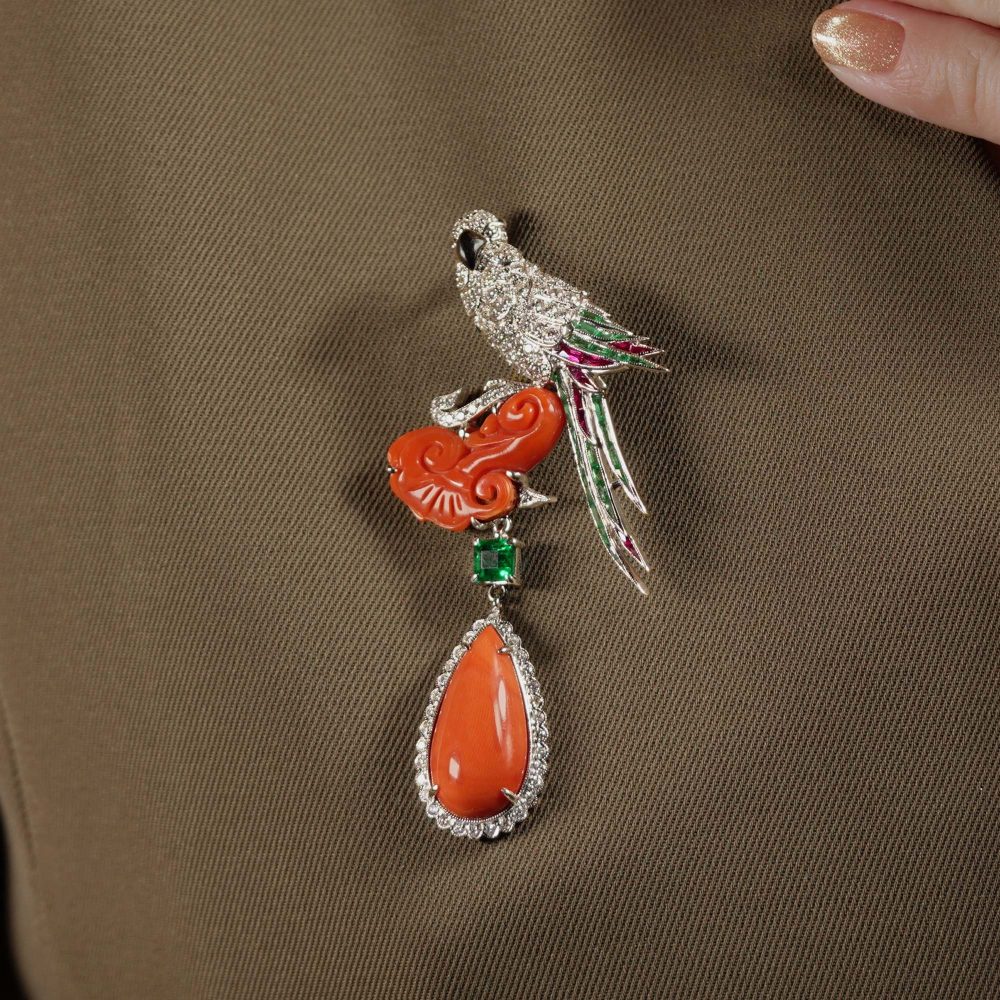
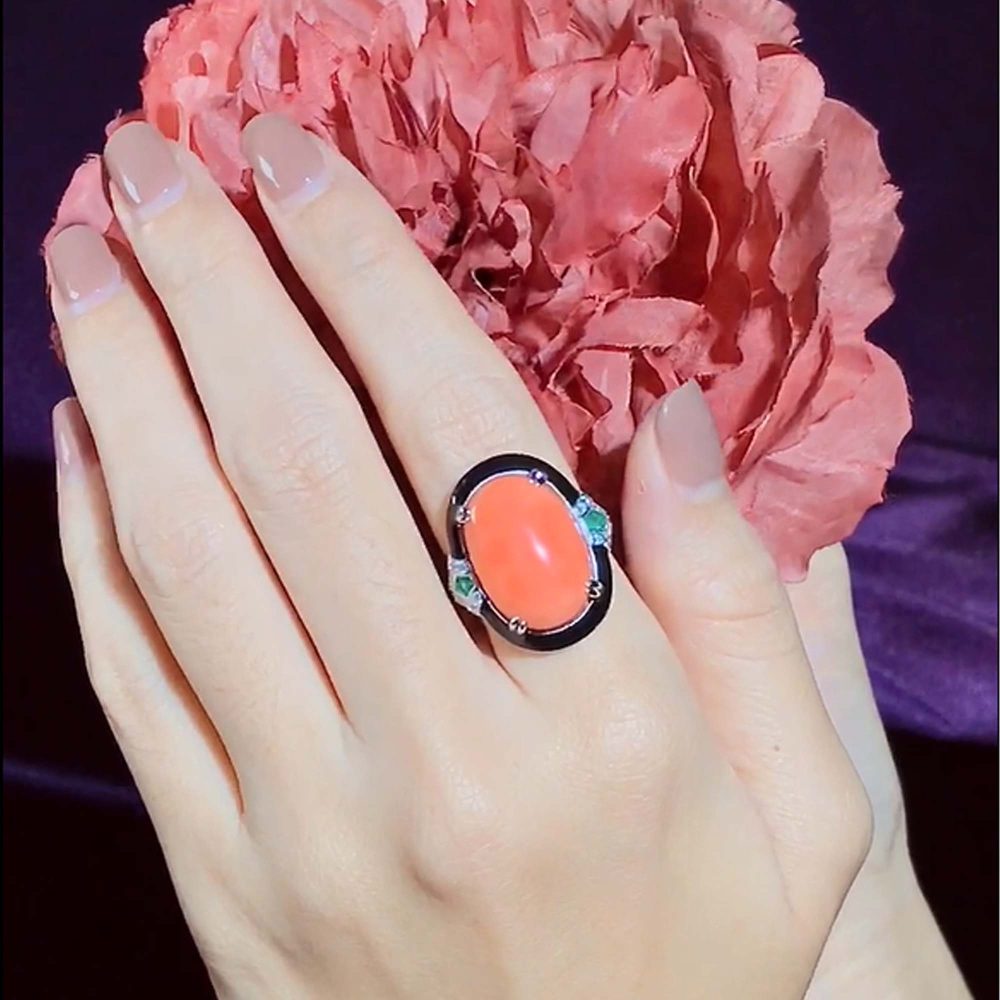
Workshop insight: We treat coral as a design material for pieces that are worn and then removed, not for pieces that live on a hand through cooking, cleaning, and handbag straps. In practice that means brooches, earrings, and pendants first, and cocktail rings that are worn deliberately rather than daily. When we do set coral in a ring, we bezel it and we keep the stone slightly below the plane of the surrounding metal, so that the gold takes the knock instead of the coral. It is a small decision at the bench that decides whether a piece survives a decade.
The same logic applies to coral beads. Knotting between beads is not decorative fussiness; it prevents the beads from grinding against one another and stops the entire strand from scattering if the thread parts. Coral strands should be restrung periodically, exactly as pearls are.
Is Coral Dyed or Treated?
Frequently, and the treatments in commercial use are more varied than for most gems. GIA lists four in current practice: dyeing, bleaching, impregnating with wax, and stabilizing with plastic. Each addresses a different shortcoming. Dyeing raises pale or off-color material to a saleable red or pink. Bleaching lightens dark or discolored material. Wax and polymer fill the pores of coral that is too soft or too porous to take a good polish on its own.
Beyond treatment lies substitution, and here the terminology deserves care. Reconstituted coral is not a treated gem but a manufactured one: GIA describes it as “bits and pieces of other coral, glued together with adhesives, and then dyed.” Outright imitations are more numerous still — glass, various plastics, dyed limestone, ceramics, bone, and marble all appear on the market as coral.
What to Look For
- Color that pools in the fissures. Dye concentrates in growth channels and surface cracks, so an unnaturally dark line running through an otherwise even stone is a strong indicator.
- Structure under magnification. Precious coral shows a fine, parallel growth striation and, in cross-section, a concentric structure. Plastic shows flow lines and mold seams; glass shows gas bubbles.
- Weight and temperature in the hand. Plastic imitations are noticeably lighter and warm to the touch faster than a calcium carbonate gem does.
- Uniformity that is too perfect. Natural precious coral of even color and free of visible flaws exists, but it is expensive. Flawless, saturated, inexpensive coral is almost always dyed, reconstituted, or artificial.
Workshop insight: Our position on coral is the same one we take on every treated material: the treatment is not the problem, the silence around it is. Dyed bamboo coral is a legitimate material with a legitimate place, and a good deal of the antique-style coral jewelry in circulation contains it. What is not legitimate is allowing the single word “coral” to carry the price of Corallium rubrum while the material in the setting is dyed and resin-filled. We name the species and the treatment, and we would encourage any buyer to ask a seller who does not.
How Is Coral Used in Art Deco-Inspired Jewelry?
Coral jewelry meaning was carried into modern design by two distinct moments in European jewelry, and they produced very different objects. The first was Victorian: carved coral cameos, branch brooches, teething rings, and the graduated bead necklaces that were a standard christening and coming-of-age gift through the nineteenth century. Torre del Greco, on the Bay of Naples, supplied much of this work and has remained a center of coral carving ever since, part of a manufacturing tradition in coastal southern France and western Italy that GIA dates back roughly three centuries.
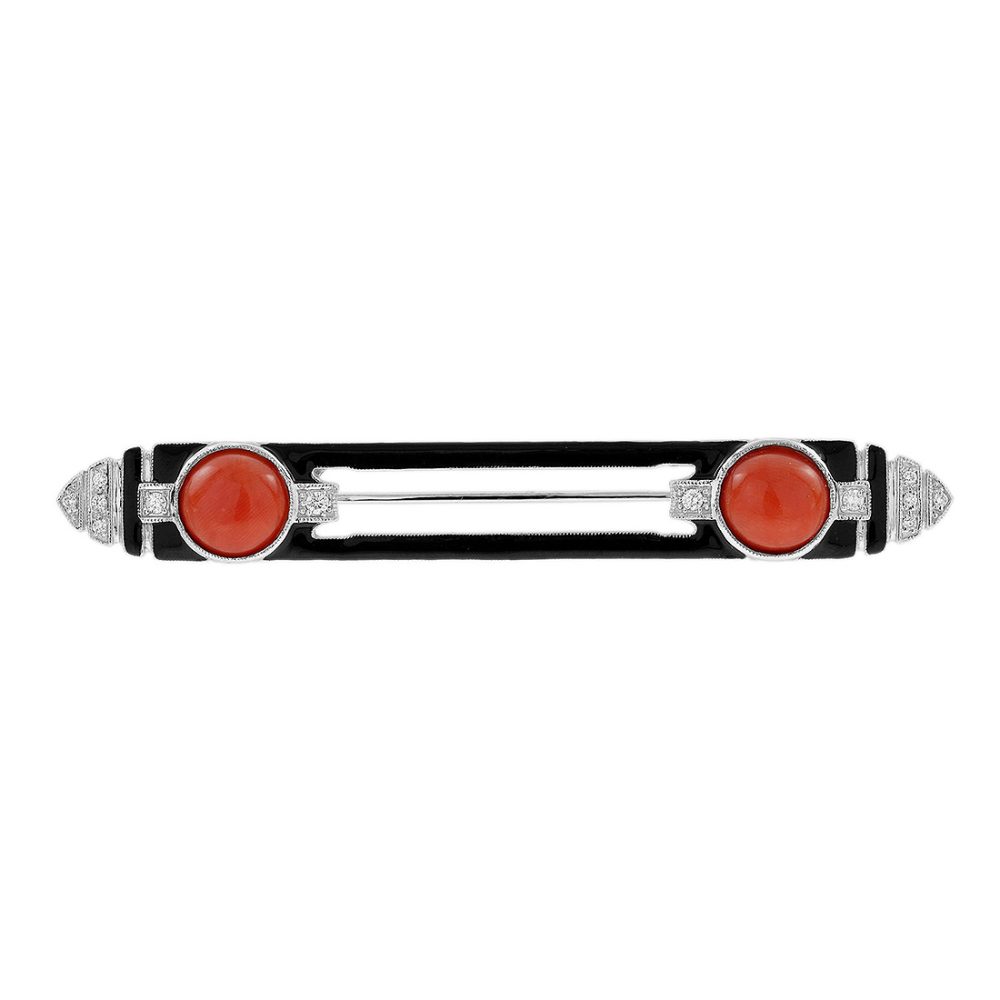
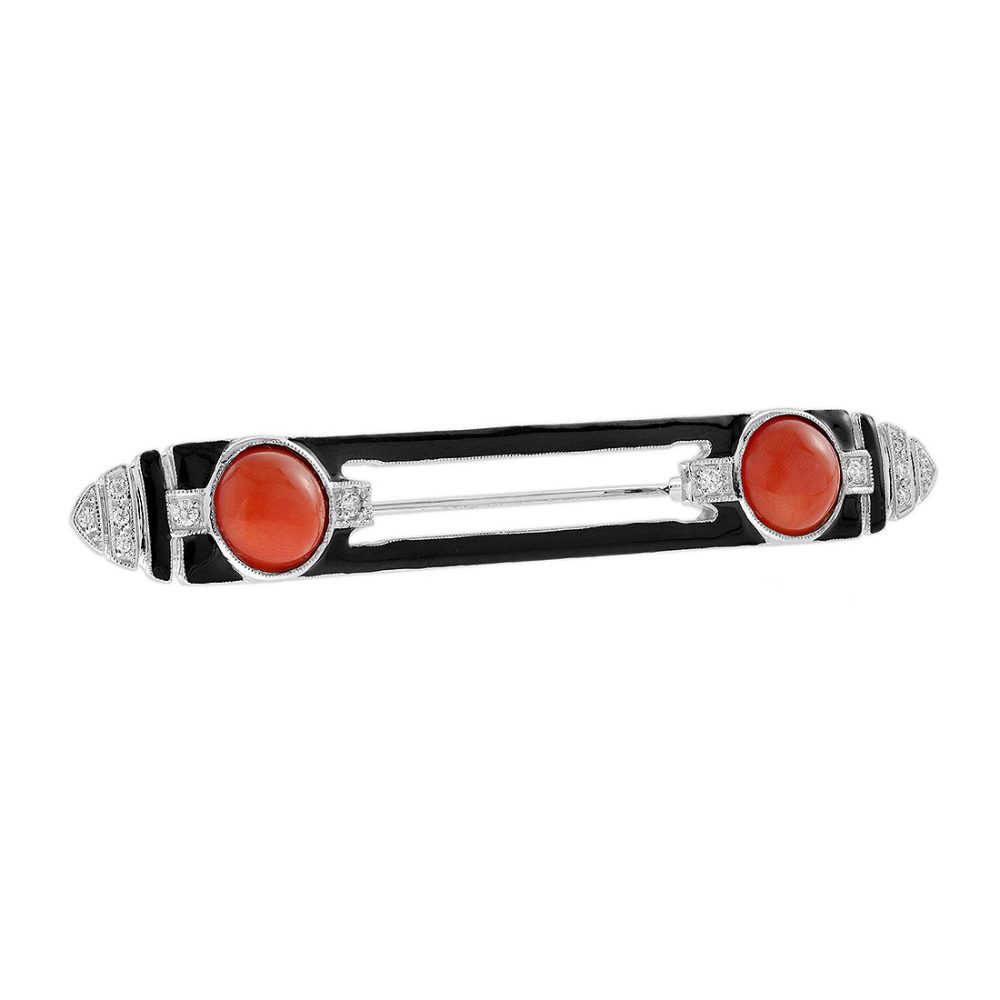
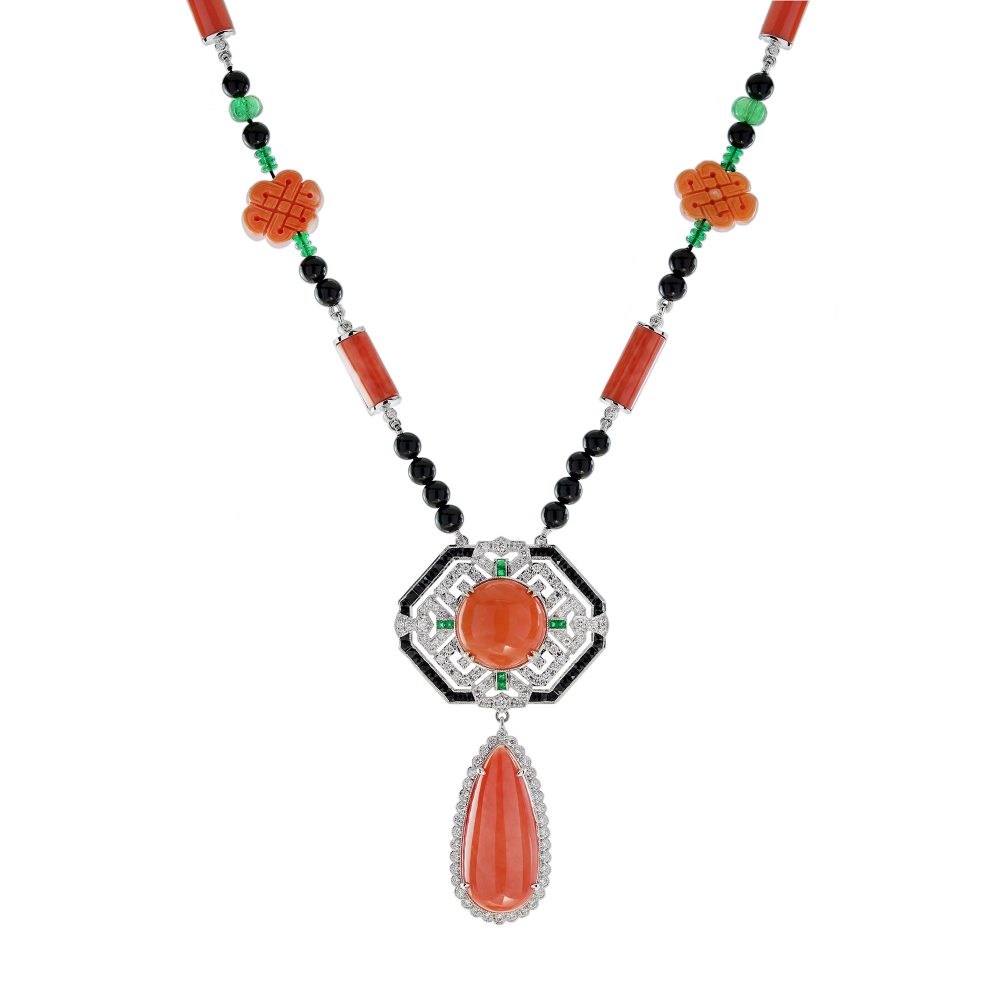
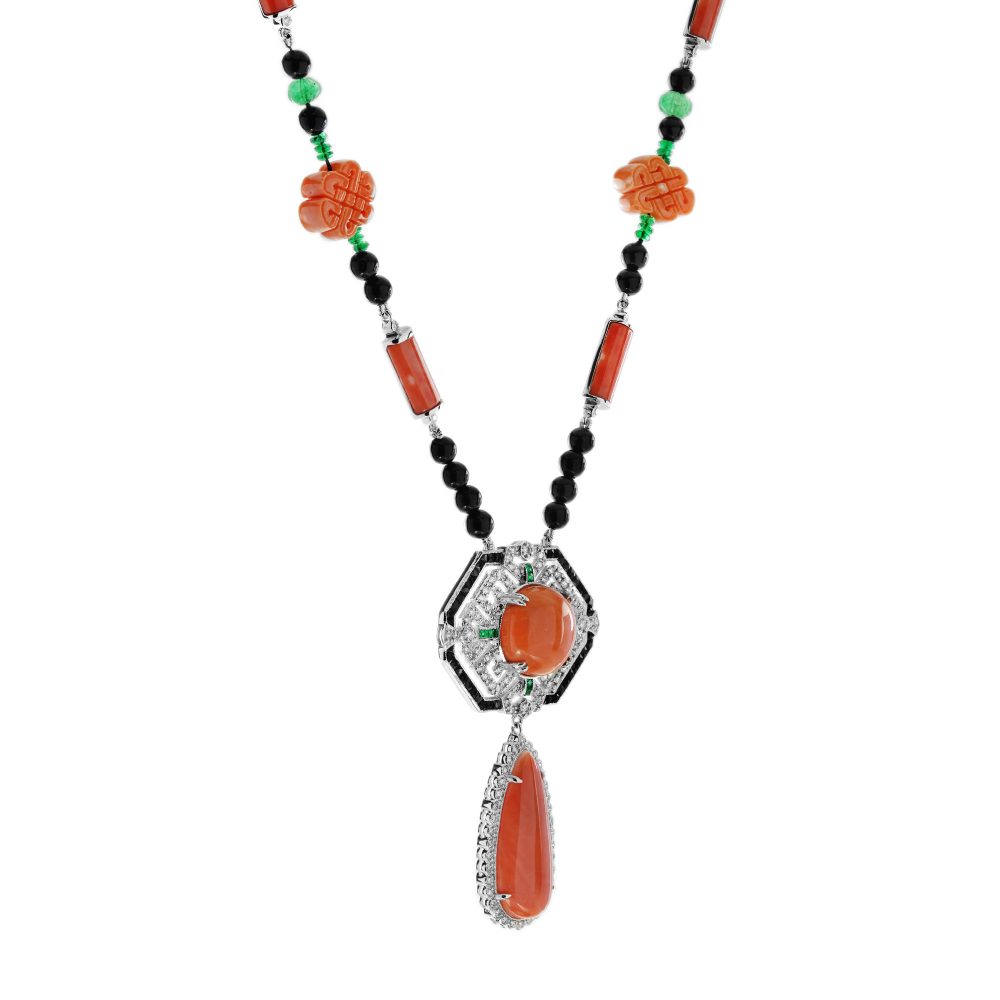
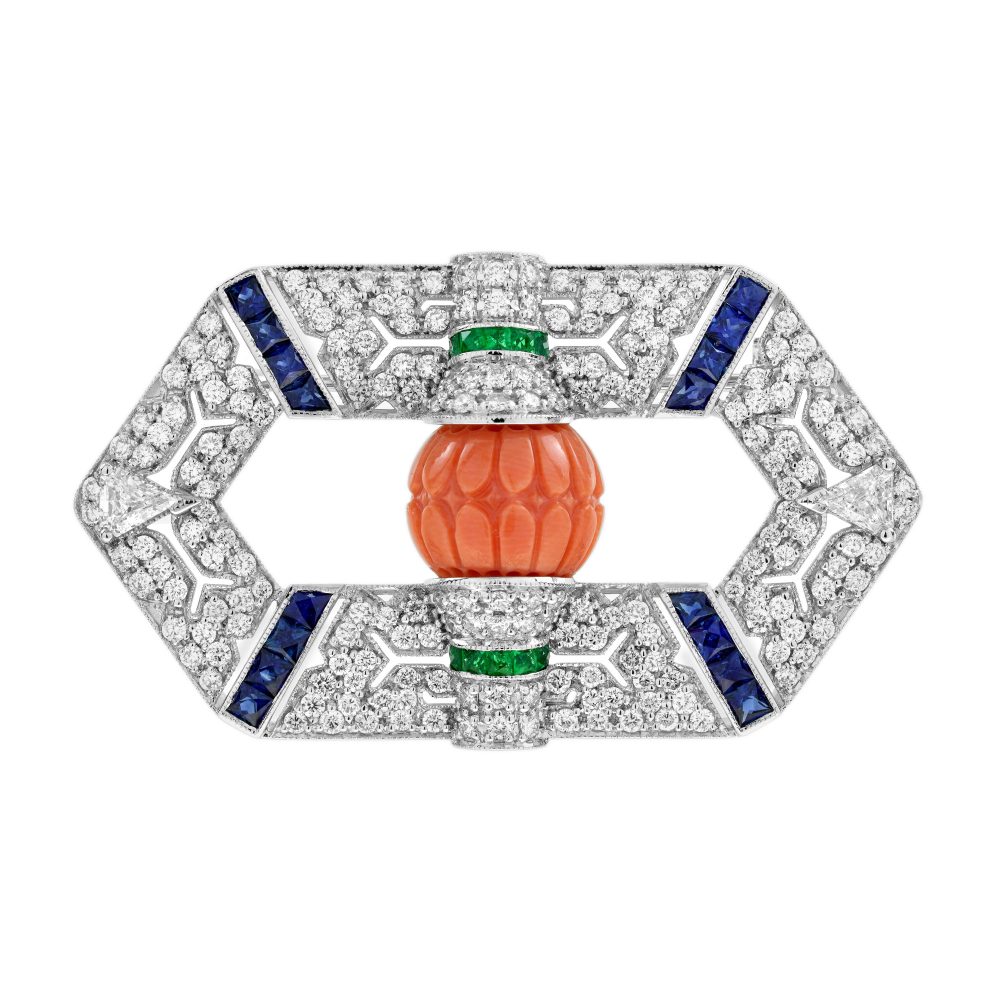
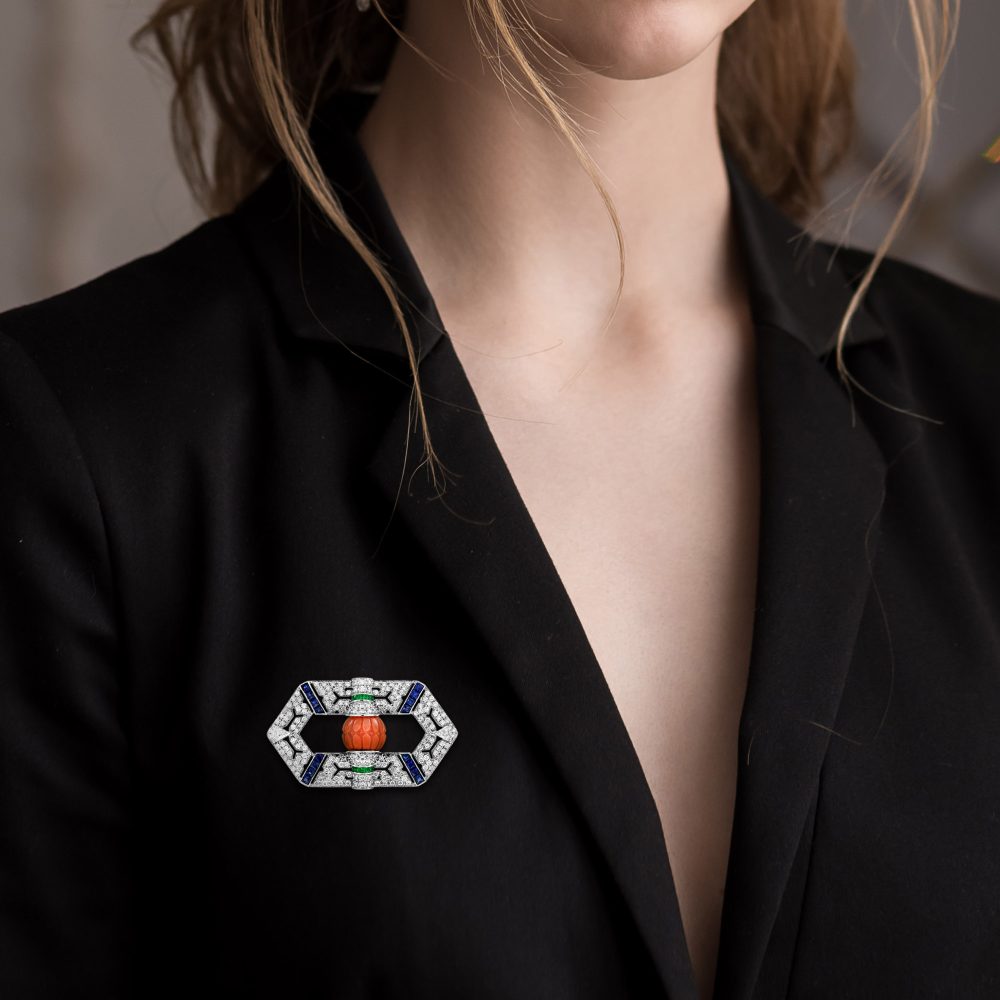
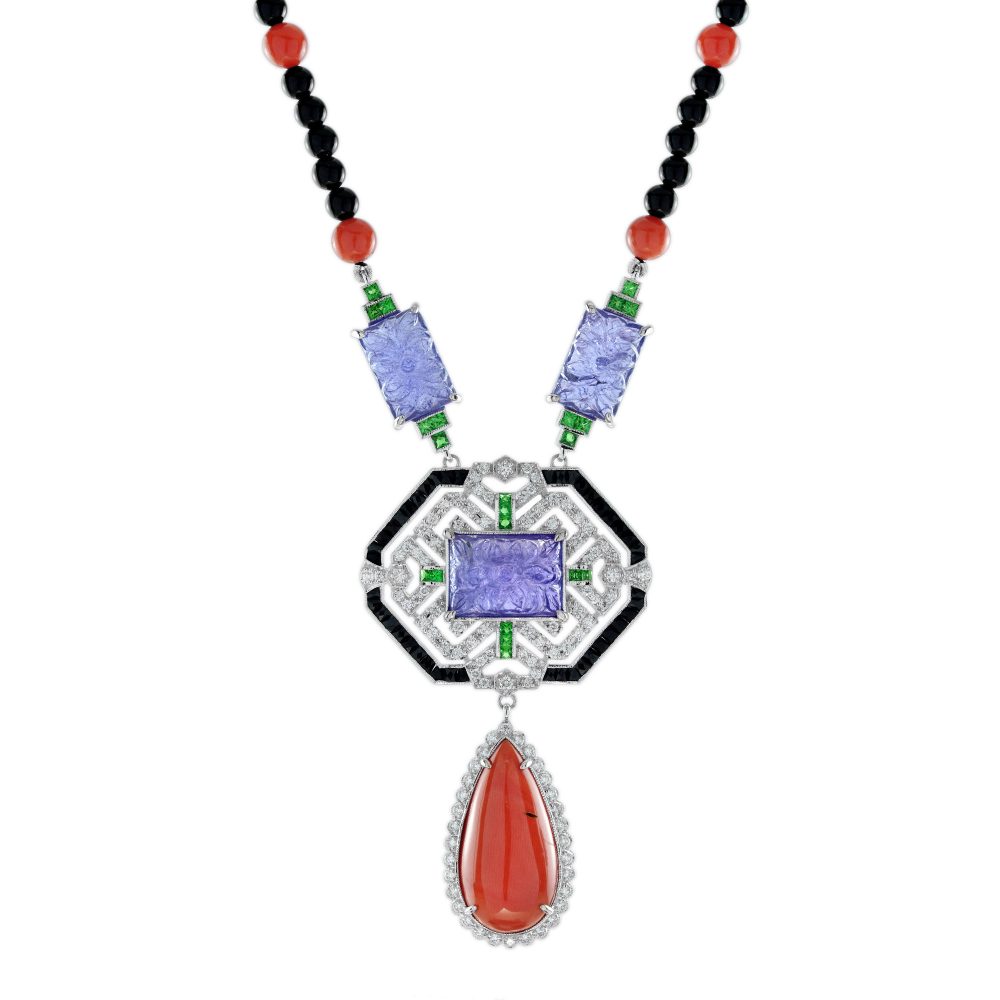
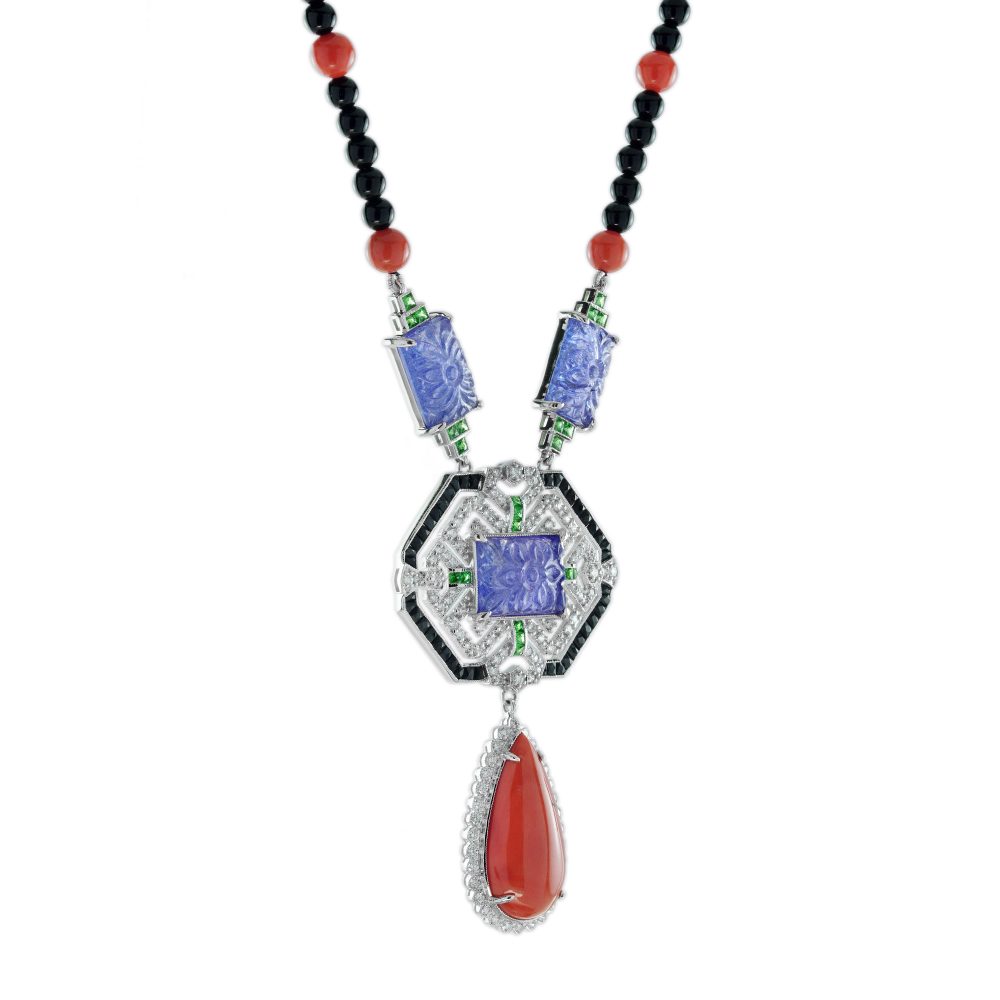
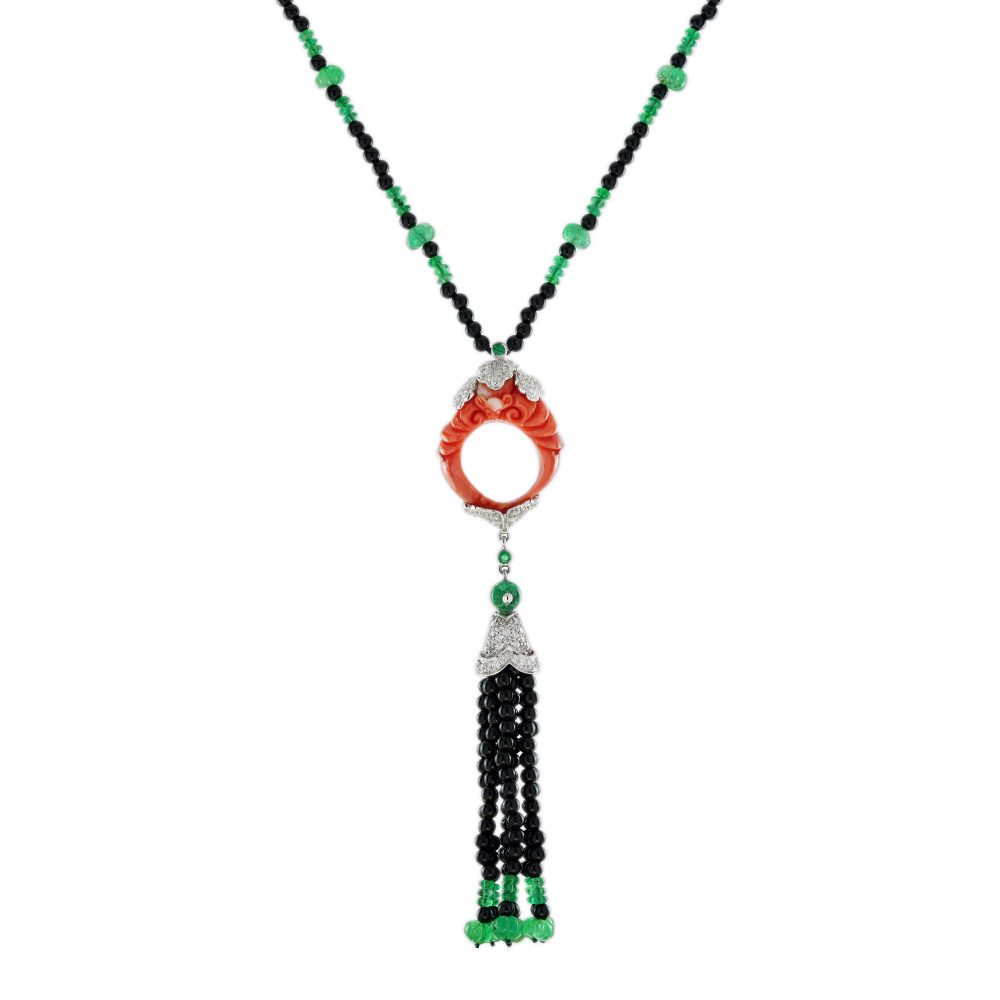
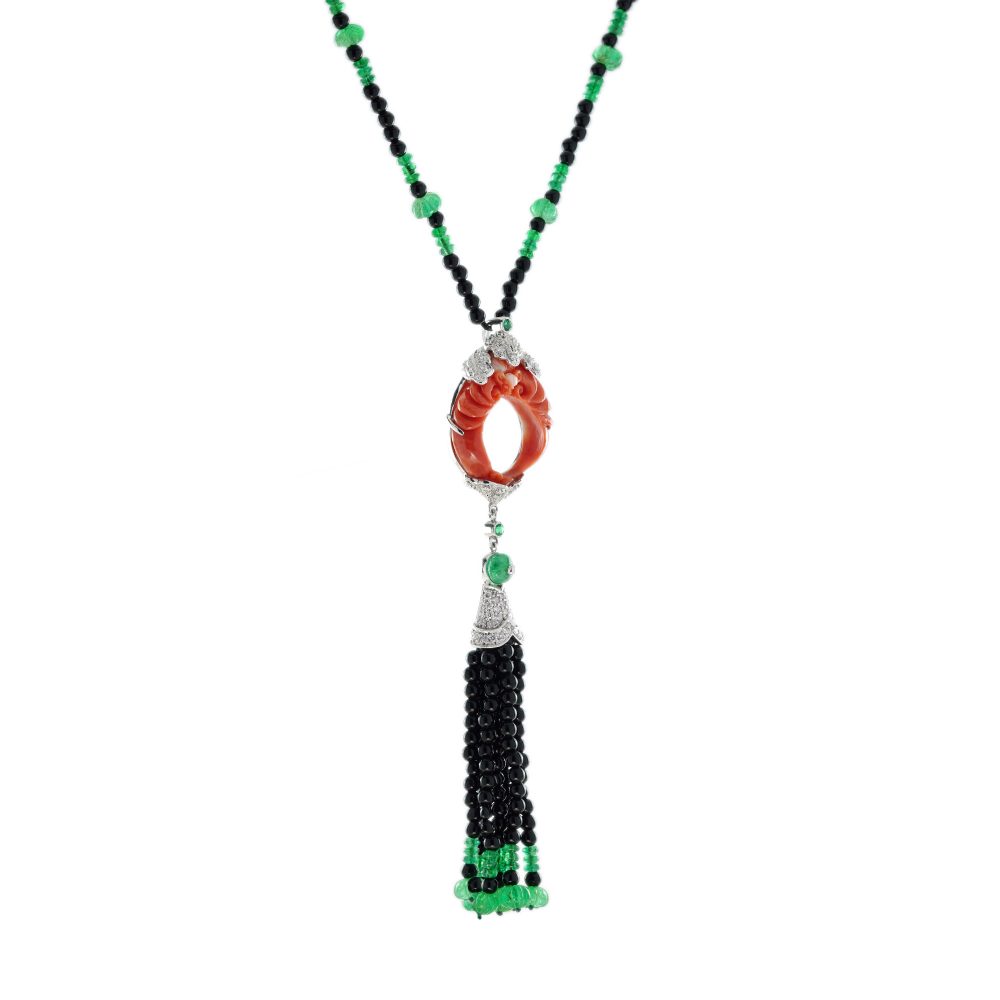
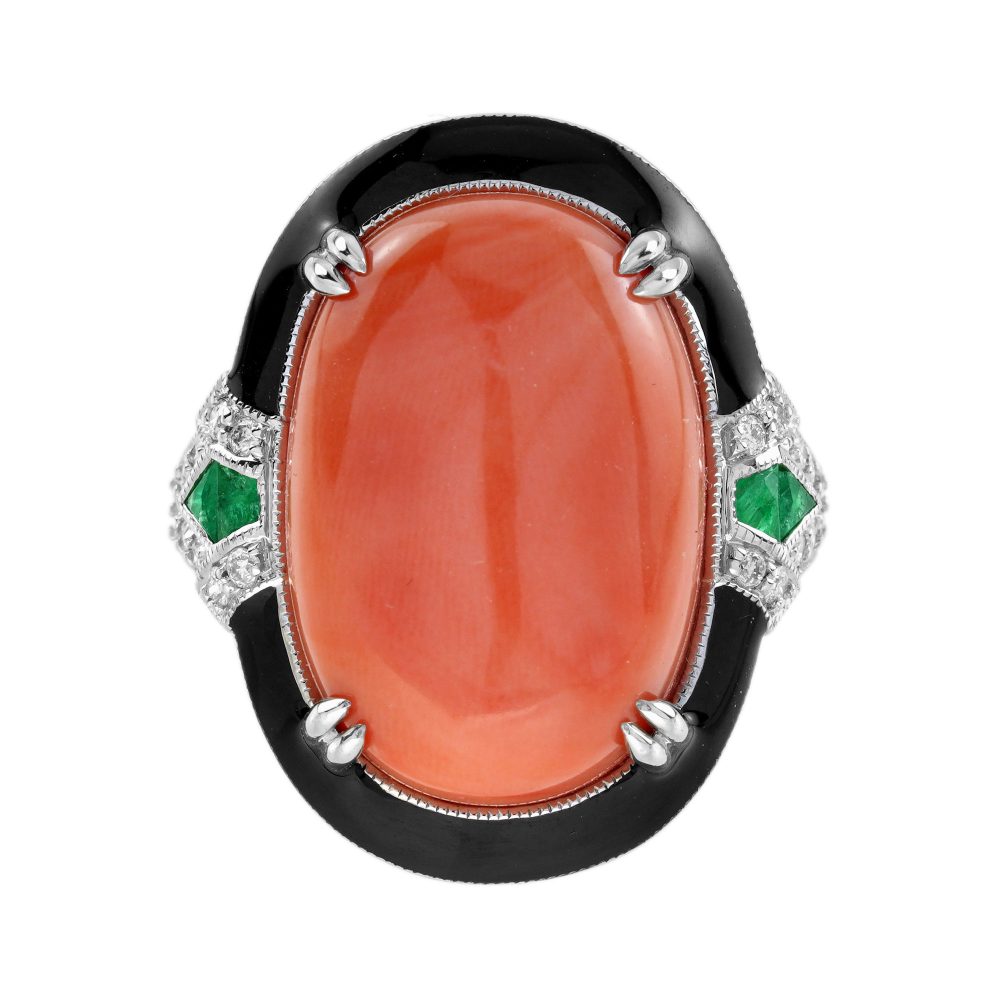
The second moment was the 1920s and 1930s, when Art Deco designers rediscovered coral as a block of pure, opaque color. The style favored flat planes of contrasting material over graduated shading, and coral’s dense orange-red sat against black onyx, white diamond, and the cool green of jade in exactly the way the period wanted. Chinese and Japanese design motifs, then fashionable in Paris, brought carved coral plaques and beads into brooches, pendants, and cigarette cases.
Common Design Pairings
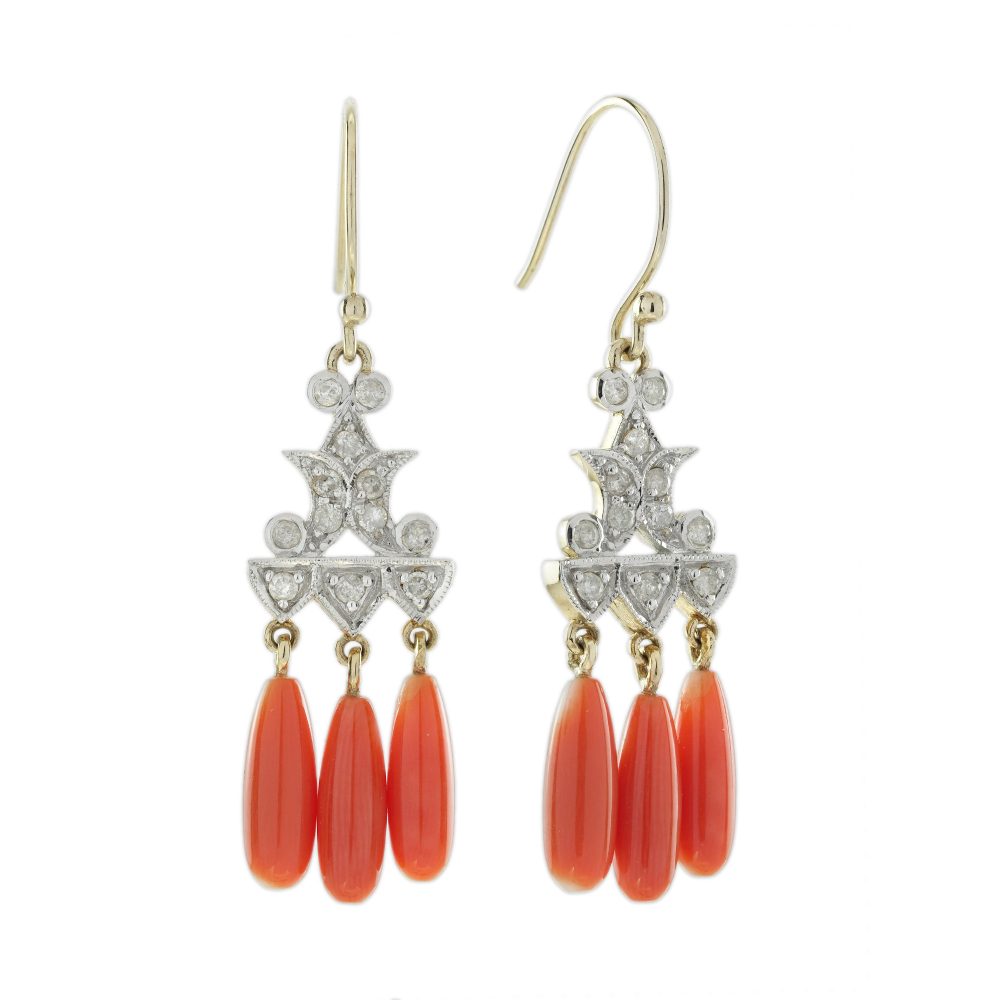
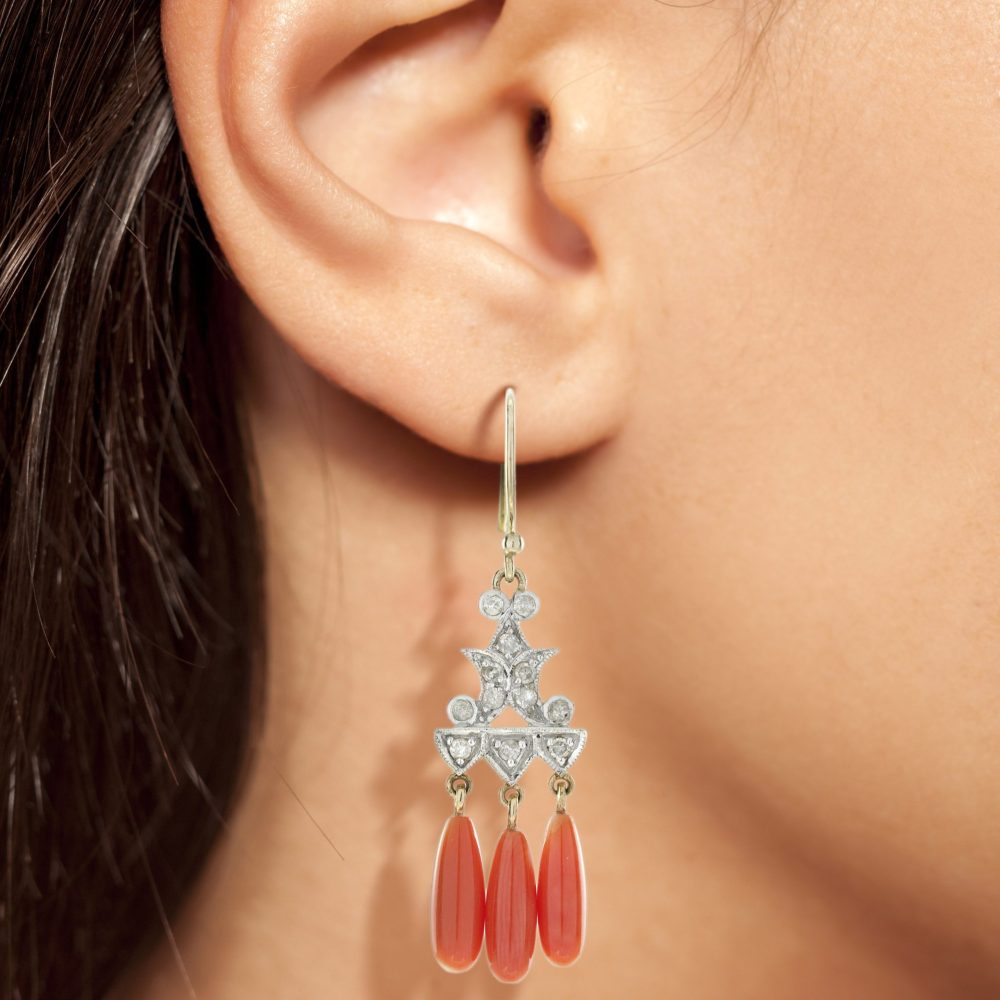
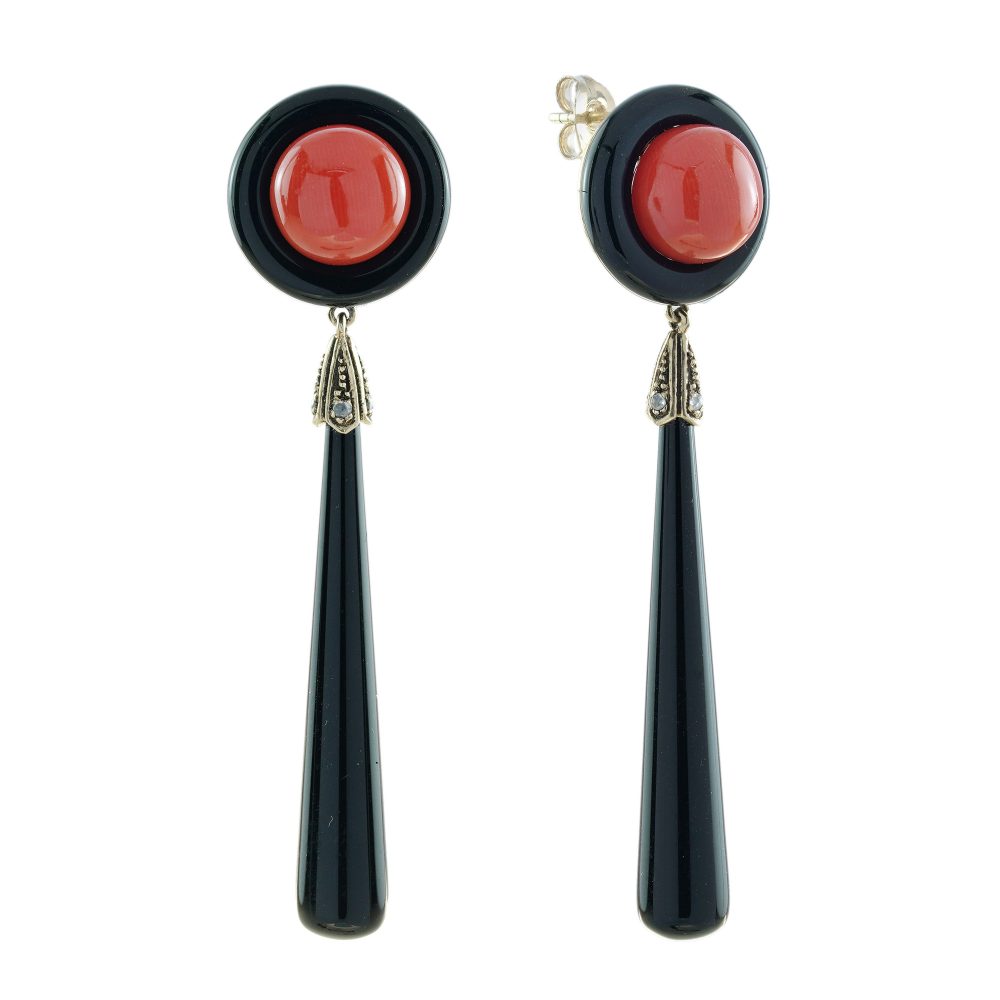
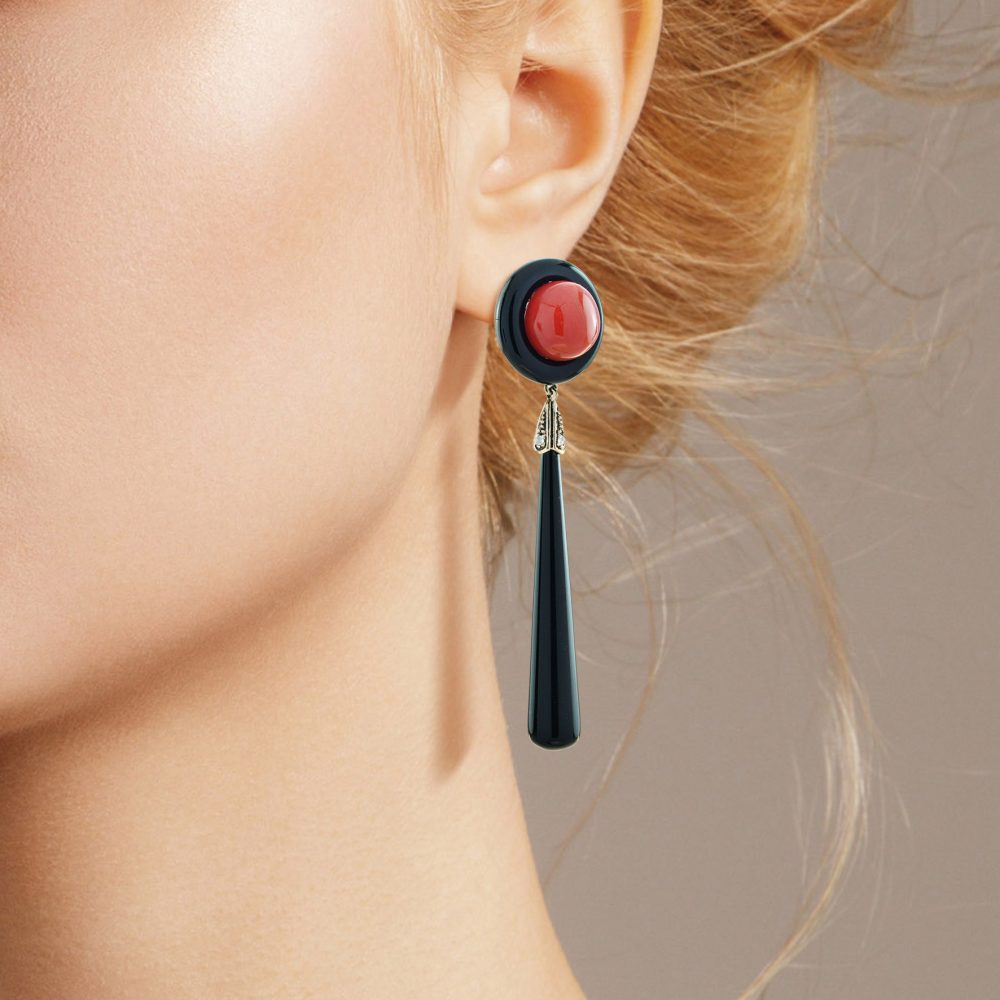
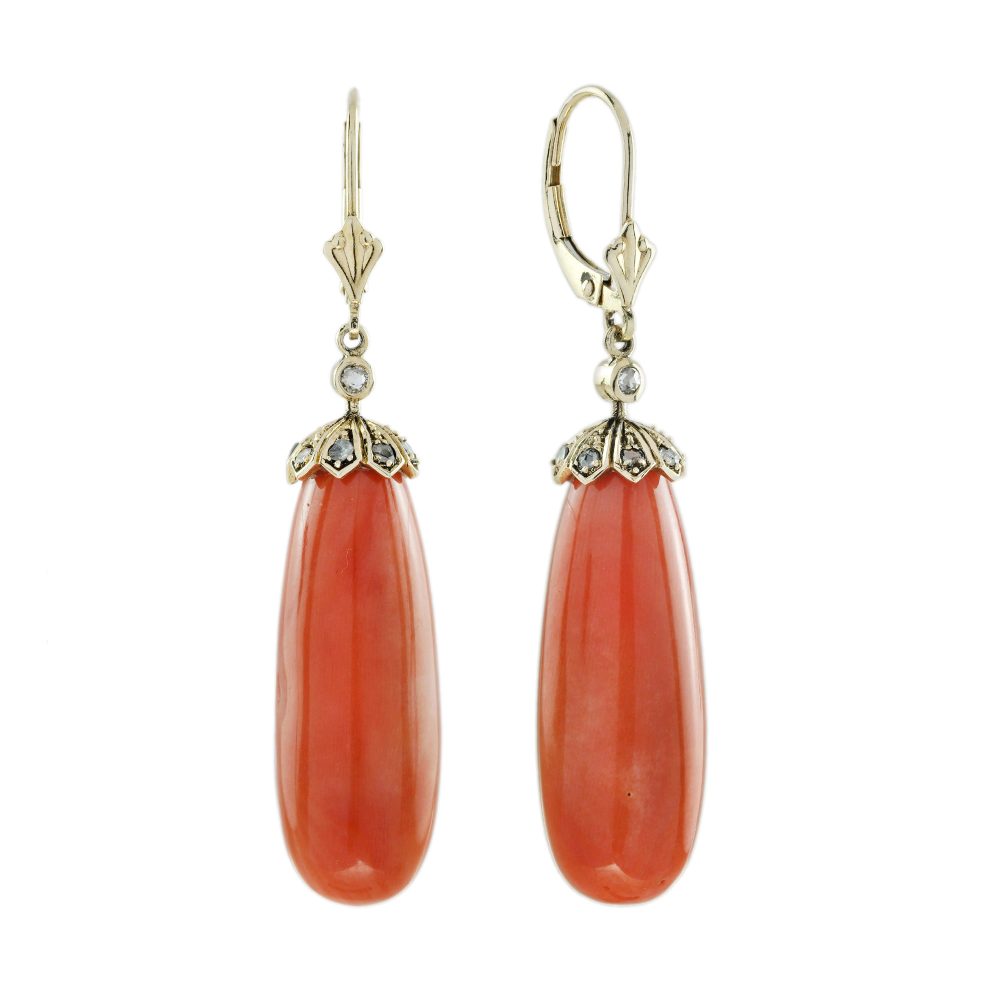
Coral with onyx and diamond remains the defining Deco combination: the red supplying warmth, the black supplying structure, and the diamond supplying the line. Coral with jade or with pearl produces a softer, more Edwardian result. In our own workshop, coral appears most often as bezel-set cabochons and carved plaques in brooches, drop earrings, and pendants, set in solid gold alongside diamond melee, with the stepped outlines and precise geometry that the period is known for.
Our own work is made with natural gemstones set in solid gold. Every piece is newly made and antique-inspired; it is not an antique, an estate piece, or a period original.
Related: Explore our coral jewelry
How Do You Choose Fine Coral?
- Establish what the material actually is. Coral jewelry meaning is worth very little if the material carrying it has been misdescribed. Ask whether the piece is precious coral of the family Coralliidae or a common coral such as bamboo or sponge. The two are separated by an order of magnitude in price and are not interchangeable, however similar they look once polished.
- Judge color evenness before color intensity. A uniform, unblotched tone is the strongest indicator of quality in both red and angel-skin pink. Patchiness, white flecking, and visible growth channels lower the grade.
- Examine the polish. Fine precious coral takes what CIBJO calls a “porcelain like lustre.” A waxy, dull, or pitted surface points either to poorer material or to careless finishing, and in porous material it often points to wax or polymer filling.
- Assess the carving on its own terms. Because coral is worked rather than faceted, the carver’s hand is a major part of the value. Crisp undercutting, symmetry, and confident detail distinguish serious work from production output.
- Require disclosure of treatment. Dye, bleach, wax, and polymer are all in routine use. A seller who cannot say which, if any, have been applied is a reason for caution.
- Match the setting to the wear. At Mohs 3 to 4, coral belongs in a bezel or a protected mounting, and it belongs in categories of jewelry that see less contact — earrings, brooches, pendants — before it belongs in a ring worn every day.
How Do You Care for Coral?
Care is where coral jewelry meaning becomes a practical matter rather than a historical one, because coral requires the most conservative cleaning routine of any material in a fine jewelry collection. Wipe it with a soft cloth, slightly damp if necessary, and dry it immediately. GIA advises briefly rinsing in warm, soapy water rather than soaking, and we would treat even that as the outer limit — for treated or reconstituted material, prolonged water contact can affect adhesives and fillers.
The prohibitions matter more than the method:
- Never use an ultrasonic or steam cleaner. Vibration propagates existing fissures in a poorly tough material, and heat is a separate hazard.
- Never use a chemical jewelry dip, and avoid acid in any form. Calcium carbonate dissolves in acid; perfume, hairspray, lemon, vinegar, and most household cleaning products will etch the polish beyond recovery.
- Avoid chlorinated water and prolonged direct sunlight. Both can fade color over time, and dyed material fades faster than natural.
- Apply cosmetics first, jewelry last. This single habit prevents most of the damage we see on coral brought in for repair.
- Store coral separately and padded. At Mohs 3 to 4, virtually every other gem in the box will scratch it.
Have settings checked periodically, as with any fine piece, and have coral bead strands restrung when the knots begin to loosen or discolor. Coral that is worn thoughtfully and cleaned gently keeps its polish for generations; coral that spends an afternoon in an ultrasonic bath rarely recovers.
What Should You Remember About Coral?
Coral is best understood as three separate questions held apart. Coral jewelry meaning is genuinely ancient and genuinely protective, attested by Ovid and Pliny, carried through Renaissance painting and Victorian nurseries, and it does not require modern embellishment to be interesting. Its identity is specific: precious coral of the family Coralliidae, a deep-water animal skeleton colored by carotenoids, quite distinct from the reef corals it is constantly confused with and from the dyed bamboo and sponge material sold under the same name.
And its practical character is unambiguous. At Mohs 3 to 4, poor in toughness, and soluble in acid, coral is a material for protected settings and deliberate wear. Chosen with a clear understanding of what it is, set so that metal absorbs the knocks, and cleaned with nothing more aggressive than a soft cloth, coral earns its place in a collection through two thousand years of documented use — not through a symbolism invented to sell it.
Sources: GIA 4Cs — Coral Jewelry: History, FAQs & Care · GIA Gems & Gemology — Italian Precious Coral · GIA — Historical Reading List: Mediterranean Precious Coral · CIBJO — Precious Coral Guide (November 2024) · Gem-A — Breaking Down the Misunderstandings About Precious Coral · SSEF — Precious Corals Gem Guide · Jewelers of America — Official Birthstone List
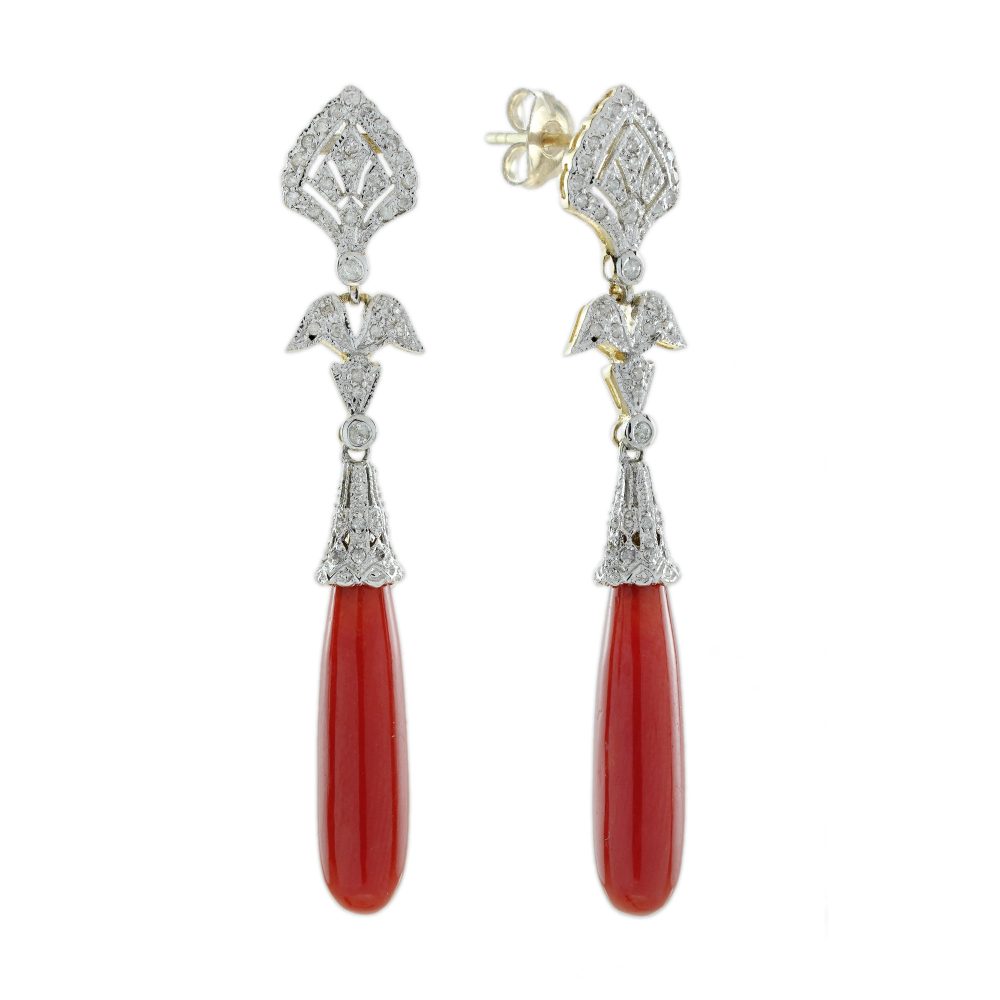
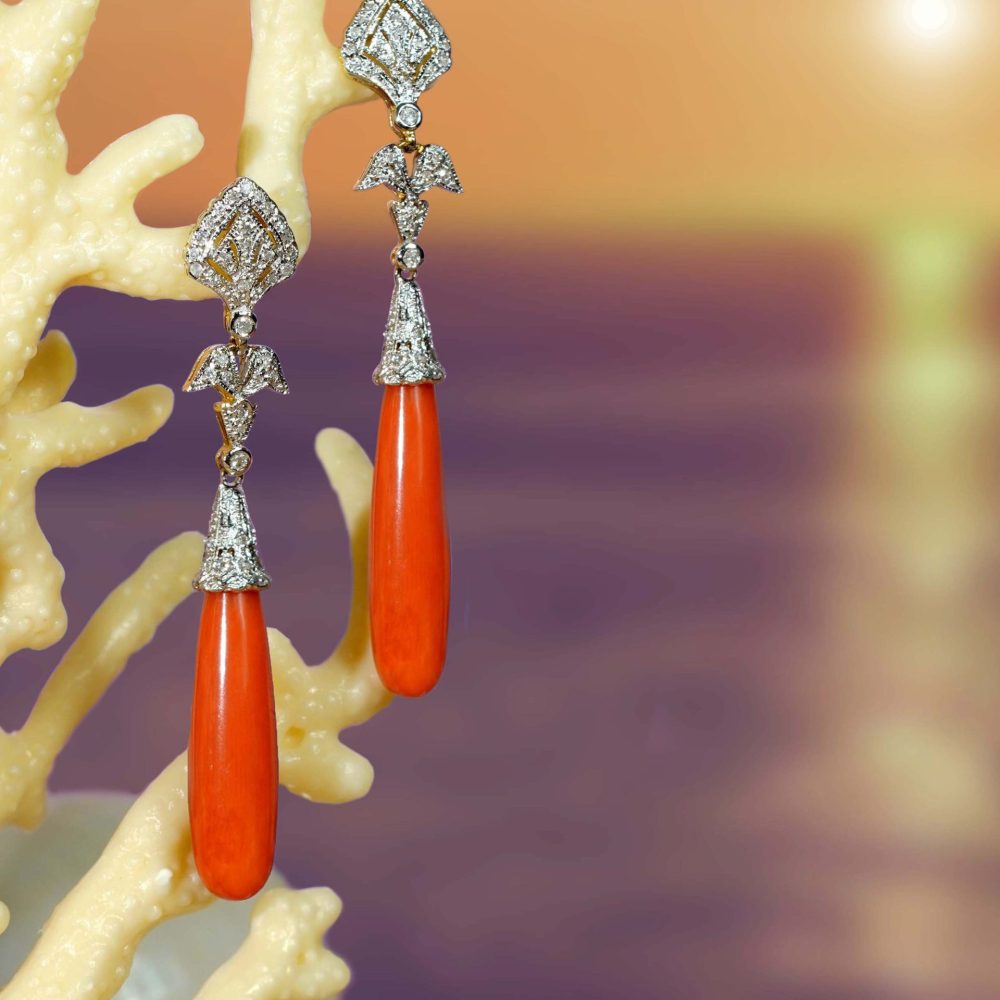
Yellow Gold
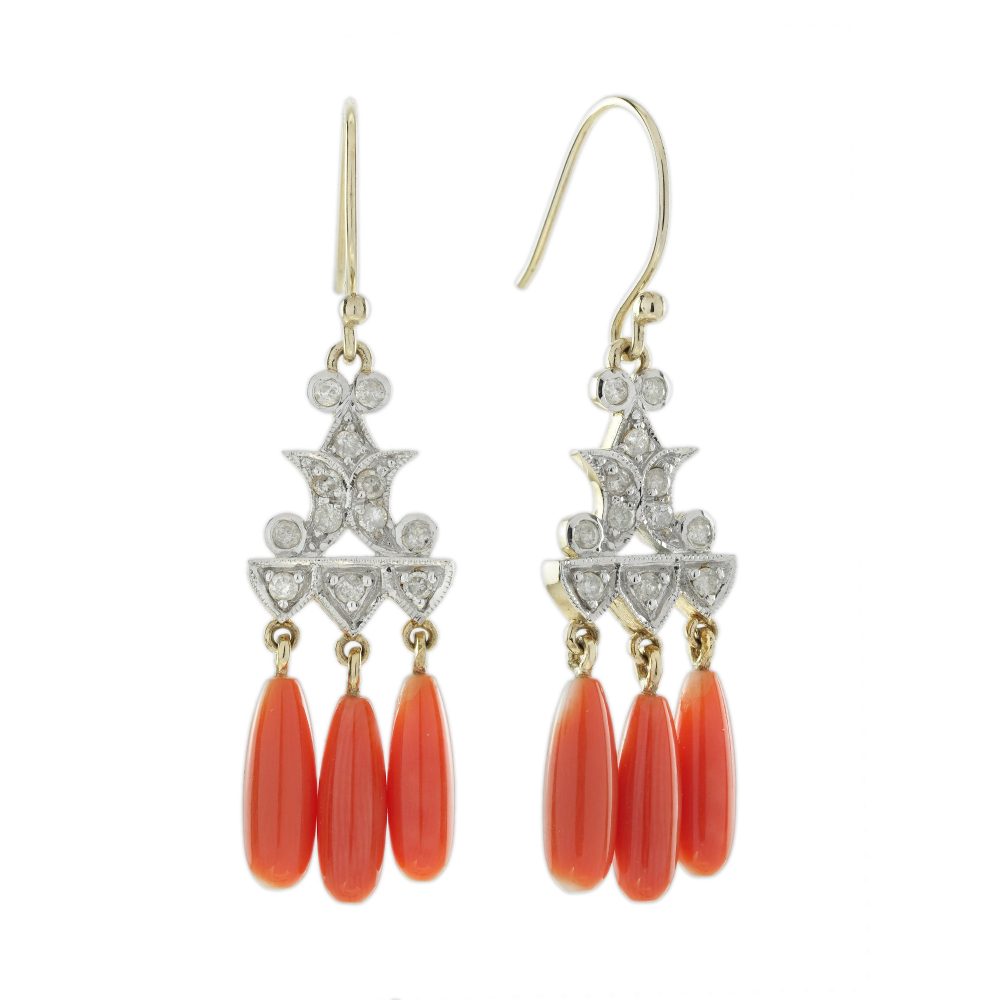
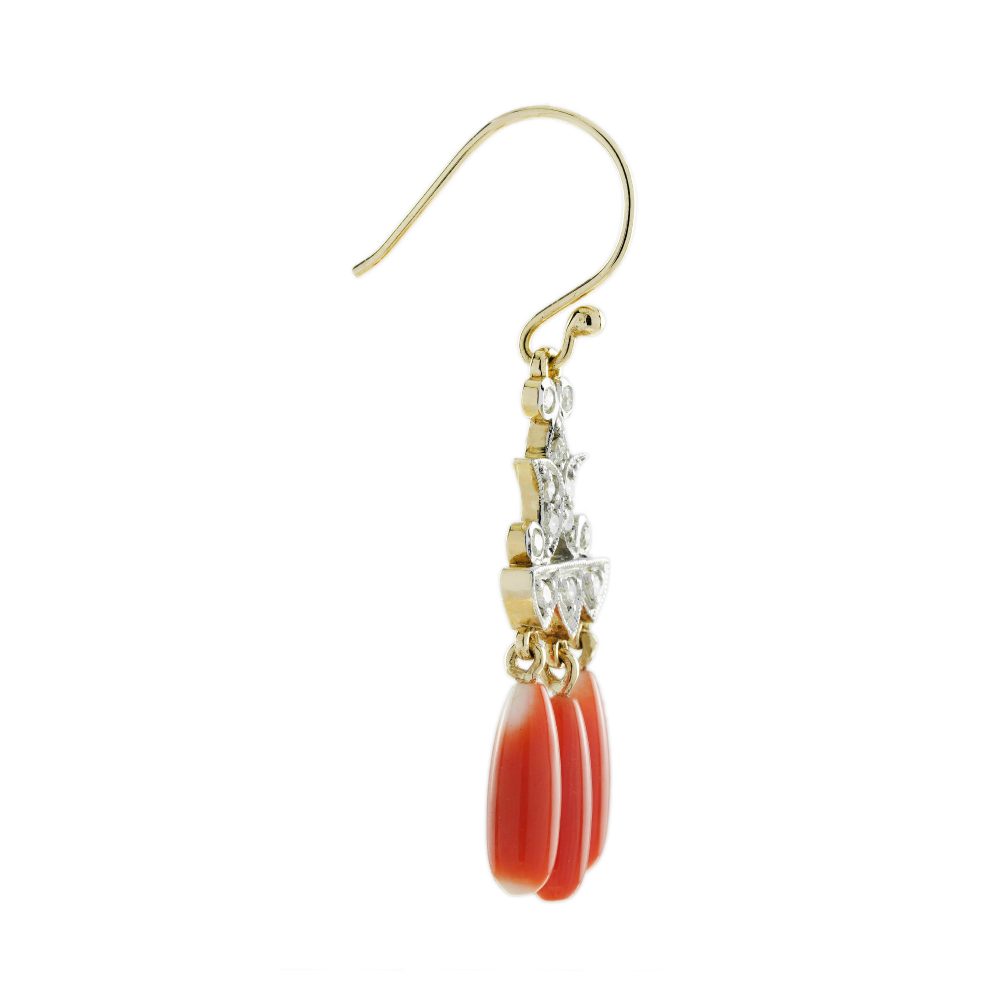
Yellow Gold

Frequently Asked Questions About Coral Jewelry
Is coral a birthstone?
No. Coral is not listed as an official or alternate birthstone for any month by Jewelers of America. It is commonly cited as the material for the thirty-fifth wedding anniversary and appears in several zodiac and regional astrological traditions, but neither convention is the calendar-month birthstone list, and neither confers official birthstone status.
Is coral jewelry bad for coral reefs?
Precious coral is not reef coral. The material used in fine jewelry belongs to the family Coralliidae and grows in cold, dark, deep water, generally between 80 and 2,000 meters depending on species. It is a different animal in a different ocean layer from the shallow tropical reef corals affected by bleaching, and Mediterranean harvesting is regulated by minimum depth and branch-diameter rules.
Is coral jewelry dyed?
Often. GIA lists dyeing, bleaching, wax impregnation, and polymer stabilization as coral treatments in commercial use, and reconstituted coral is made from fragments glued together and dyed. Dye typically concentrates in growth channels and surface fissures. We name the species and the treatment rather than let the single word “coral” imply untreated precious material.
How do you clean coral jewelry?
Wipe coral with a soft, slightly damp cloth and dry it immediately. Never use an ultrasonic cleaner, a steam cleaner, or a chemical jewelry dip. Because coral is calcium carbonate, it dissolves in acid, so perfume, hairspray, lemon, vinegar, and most household cleaners will etch the polish. Apply cosmetics first and put jewelry on last.