
Blog, Gemstone Guides
Citrine Meaning & November Birthstone Guide
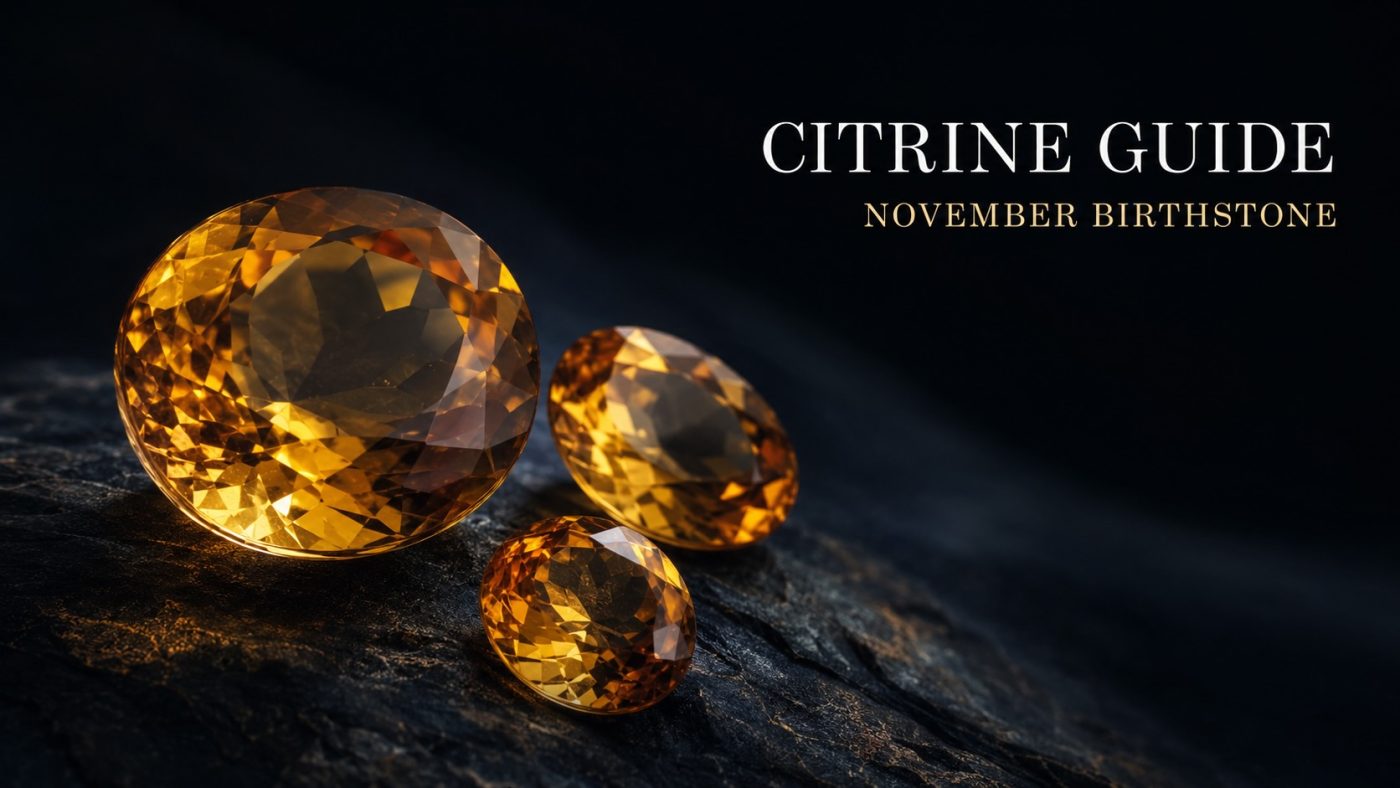
Key Takeaways: Citrine Meaning
- Citrine traditionally symbolizes warmth, optimism, generosity and abundance; these are cultural associations rather than physical or financial effects.
- Citrine is yellow to orange quartz and shares November birthstone status with topaz.
- It measures Mohs 7 with good toughness, although hardness does not make a stone immune to chips, scratches or thermal stress.
- Most citrine in the market is heat-treated amethyst, an accepted practice that should be disclosed rather than confused with origin or quality.
What Is the Meaning of Citrine?
Citrine traditionally symbolizes warmth, optimism, generosity and abundance, associations inspired by its yellow-to-orange color. It is an official November birthstone alongside topaz and belongs to the quartz family. These meanings are cultural rather than medical or financial claims; the gem itself is valued for color, clarity, wearability and design.
What Does Citrine Symbolize?
Citrine meaning begins with color. Its yellow, golden and orange tones evoke sunlight, autumn, warmth and cultivated plenty. Over time, those visual associations developed into a symbolic vocabulary of optimism, generosity, confidence, welcome and abundance.
The word abundance requires precision. In jewelry writing it describes a cultural association, not a promise that the stone will attract wealth or improve financial outcomes. Likewise, optimism and confidence are meanings a wearer may assign to a jewel; they are not medical or psychological effects produced by quartz.
This distinction does not weaken the symbolism. A jewel can carry genuine personal significance without making a measurable claim. Citrine may commemorate a November birthday, an anniversary in autumn, a professional milestone or a period when warmth and clarity mattered to the wearer. The meaning comes from the relationship between person, occasion and object.
Golden citrine meaning is often expressed through the image of stored sunlight. That phrase works best as metaphor. A pale lemon stone may suggest clarity and restraint, while a deep orange stone may convey warmth and ceremony. Brownish-orange material can feel architectural and grounded rather than bright. The exact color makes the symbol more specific.
At Lilly M. JEWELERS, our workshop treats symbolism as a design instruction. If the intended idea is lightness, we may favor an open composition and a paler stone. If the intended idea is warmth or inheritance, richer gold and a deeper orange center can carry that language more convincingly. The stone does not dictate one meaning; proportion, metal and setting help the wearer define it.
Why Is Citrine a November Birthstone?
Citrine and topaz are the two official November birthstones on the modern US list maintained by Jewelers of America. Citrine was added to the standardized list in 1952, extending November beyond topaz and giving the month a quartz option with a broad yellow-to-orange range.
The Lilly M. JEWELERS birthstones-by-month guide places November within the complete calendar. The shared month is useful because citrine and topaz can look superficially similar while behaving as different materials. Citrine is quartz at Mohs 7 with good toughness. Topaz reaches Mohs 8 but has perfect cleavage and may split along structural planes after a sharp blow.
A birthstone designation identifies a traditional calendar relationship. It does not guarantee rarity, treatment status, value or suitability for every jewel. A November piece should therefore be selected on two levels:
- Personal relevance: the month records a birthday, relationship or event.
- Material suitability: the gem, cut and setting fit the intended frequency and type of wear.
Citrine offers a comparatively approachable route to a large, strongly colored center stone. Topaz offers a different mineral identity and can appear in a wider commercial color range. Neither is a substitute for the other simply because both belong to November.
The color connection is nevertheless coherent. Autumnal yellow, amber and orange tones suit November in the Northern Hemisphere and have helped citrine become visually associated with the month. That seasonal reading is cultural, while the official list provides the formal birthstone designation.
What Is Citrine and How Does It Receive Its Color?
Citrine is the yellow-to-orange variety of crystalline quartz. It shares the same basic mineral family as colorless rock crystal, purple amethyst and several other quartz varieties. Its identity is determined by material and color, not by a particular shade name used in marketing.
Color in citrine is associated with iron-related centers within the quartz structure. Natural geological conditions can produce yellow quartz, but naturally colored citrine is less common than much of the material seen in the jewelry market. Heating suitable amethyst can change its purple color into yellow, orange or brownish orange. The result remains quartz and is sold as citrine when correctly described.
Color may range from pale lemon through saturated golden yellow to orange and reddish or brownish orange. Trade descriptions such as “Madeira” are used for certain warm, deeper colors, but they are not a geographic guarantee and do not by themselves establish natural color, origin or quality.
It is important to separate four questions:
- Identity: Is the stone quartz that qualifies as citrine?
- Color cause: Is the color natural, heat-induced or produced by another process?
- Origin: Where was the material mined?
- Quality: How well do color, clarity, cut and finish work together?
A confident visual opinion cannot always answer every question. Color zoning, inclusions and appearance may suggest a history, but origin and treatment should not be asserted from appearance alone when documentation is required.
Workshop insight: We judge citrine color in relation to the finished metal, not against a white tray alone. Yellow gold can deepen warmth but reduce color separation; white gold can sharpen the outline of a pale stone. The most successful pairing preserves the stone's identity instead of allowing metal and gem to merge into one undifferentiated yellow field.
How Does Citrine Differ From Yellow Topaz?
Citrine and yellow topaz share November birthstone status and can overlap in color, but they are not the same gemstone. Their mineral structures, hardness, breakage behavior and treatment histories differ.
| Attribute | Citrine | Yellow or Golden Topaz | Why It Matters |
|---|---|---|---|
| Mineral identity | Quartz | Topaz | Similar color does not make the materials interchangeable |
| Mohs hardness | 7 | 8 | Topaz resists scratching better |
| Toughness | Good | Poor because of perfect cleavage | A sharp blow can split topaz along a cleavage plane |
| November status | Official birthstone | Official birthstone | Both are valid calendar choices |
| Typical color range | Pale yellow to orange and brownish orange | Yellow, golden, orange or brownish tones | Identification should not rely on color alone |
| Treatment context | Most market citrine is heat-treated amethyst | Treatment depends on the topaz color and material | Disclosure should address the individual stone |
| Design priority | Balance color separation and edge protection | Protect cleavage directions and corners | Setting decisions follow structure, not color |
Topaz is harder on the Mohs scale, but hardness measures resistance to scratching. It does not measure resistance to breaking. Perfect cleavage makes topaz vulnerable to a decisive impact in a direction that citrine does not share. Citrine has lower scratch resistance but generally better toughness.
Price is not a reliable identification method. A large transparent yellow stone may be citrine, topaz, synthetic material, glass or another gem. Naming should follow gemological evidence rather than assumptions based on size, color or cost.
Blue topaz introduces a separate source of confusion. Topaz is officially a November birthstone. Blue topaz is widely marketed as a December alternative, but it is not one of the official December stones on the modern US list. A future topaz guide should address that distinction directly; this article does not use an unpublished cross-link.
What Determines Citrine Quality?
Citrine does not have a universal grading system equivalent to the diamond 4Cs, but color, clarity, cut, size, treatment and finish remain the practical assessment categories. These factors should be considered together rather than converted into a single unsupported grade.
| Factor | What to Examine | Stronger Result | Question to Ask |
|---|---|---|---|
| Color | Hue, tone, saturation and evenness | A deliberate, attractive yellow-to-orange appearance without distracting zoning | Does the color remain coherent in ordinary light? |
| Clarity | Eye-visible inclusions, fractures and cloudiness | A transparent appearance appropriate to the design | Do inclusions affect beauty or durability? |
| Cut | Symmetry, outline, facet alignment and light return | Even brilliance with limited dark or washed-out areas | Does the cut support the color rather than merely retain weight? |
| Size | Face-up dimensions as well as carat weight | Proportions suited to the jewel | Does the stone look balanced in the proposed setting? |
| Treatment | Heat or other disclosed process | Accurate, written description | What is known, and what remains unverified? |
| Finish | Polish, abrasions, chips and facet junctions | Clean surface and crisp junctions | Is pre-setting damage documented? |
Color preference is not perfectly linear. Some buyers prefer a light, clear yellow that feels restrained; others favor orange or reddish-orange depth. Saturation matters, but excessive darkness can reduce brightness. Pale stones can look washed out if the cut leaks light or the metal overwhelms the color.
Clarity is commonly high in faceted citrine, so prominent inclusions deserve attention. An inclusion may be visually interesting and entirely acceptable, but a surface-reaching fracture near a corner or prong position can affect setting risk.
Cut quality often carries more practical importance than carat weight. Quartz is available in comparatively large crystals, which means a cutter may preserve weight at the expense of proportion. A deep pavilion can hide mass below the setting, while a shallow stone may window and reveal the skin or metal beneath it.
Our workshop records face-up dimensions, depth and setting clearance before approving a center stone. Two citrines of equal carat weight can require entirely different designs. The stone that fits the architecture is usually the more convincing choice, even when it is not the larger number.
How Should Citrine Treatment Be Understood and Disclosed?
Most citrine in the market is produced by heating amethyst. Heat changes iron-related color centers within the quartz and can produce yellow, orange or brownish-orange material. This treatment is established and accepted in the jewelry trade, but acceptance does not remove the need for accurate disclosure.
Heat-treated citrine remains natural quartz because the underlying material formed in nature. Natural does not mean untreated. Those terms answer different questions. “Natural” distinguishes mined material from synthetic quartz; “untreated” describes the absence of a modification process. A seller should not use one term to imply the other.
The relevant description may include:
- mineral identity as quartz;
- commercial variety as citrine;
- known or expected heat treatment;
- any additional process, coating, dye or filling if present;
- geographic origin only when supported;
- synthetic status if the material was laboratory-grown.
Visual appearance alone may not provide a conclusive treatment history. Deep orange color, white bases on crystal clusters or amethyst-like zoning can suggest heated material, but suggestion is not documentation. Loose-stone reports, supplier records and appropriate gemological testing carry greater weight.
Treatment is not automatically a defect. The practical questions are whether it is stable under normal use, whether it affects care, whether the description is accurate and whether the price reflects the material being sold. A well-cut, disclosed heat-treated citrine can be a legitimate fine-jewelry choice.
The treatment policy for every Lilly M. JEWELERS citrine has not been confirmed in the current project record. This guide therefore explains standard industry practice without claiming that every stone in our inventory is treated, untreated or documented in the same way. Product-level representation must follow the evidence for the individual stone.
How Durable Is Citrine for Jewelry?
Citrine measures 7 on the Mohs scale and has good toughness. This makes it suitable for many jewelry formats with sensible care, but it does not make the gem immune to abrasion, chips or thermal stress.
Mohs hardness concerns resistance to scratching. Citrine can scratch materials below it on the scale, yet harder substances such as corundum and diamond can scratch citrine. Everyday dust may also contain quartz, so careless rubbing can abrade polished surfaces over time.
Toughness concerns resistance to breaking. Citrine does not have the perfect cleavage of topaz, which is an advantage, but a sharp impact can still chip a facet junction, girdle or exposed corner. Large stones and elongated cuts create more edge area that must be protected.
| Jewelry Format | Practical Suitability | Principal Risk | Design Response |
|---|---|---|---|
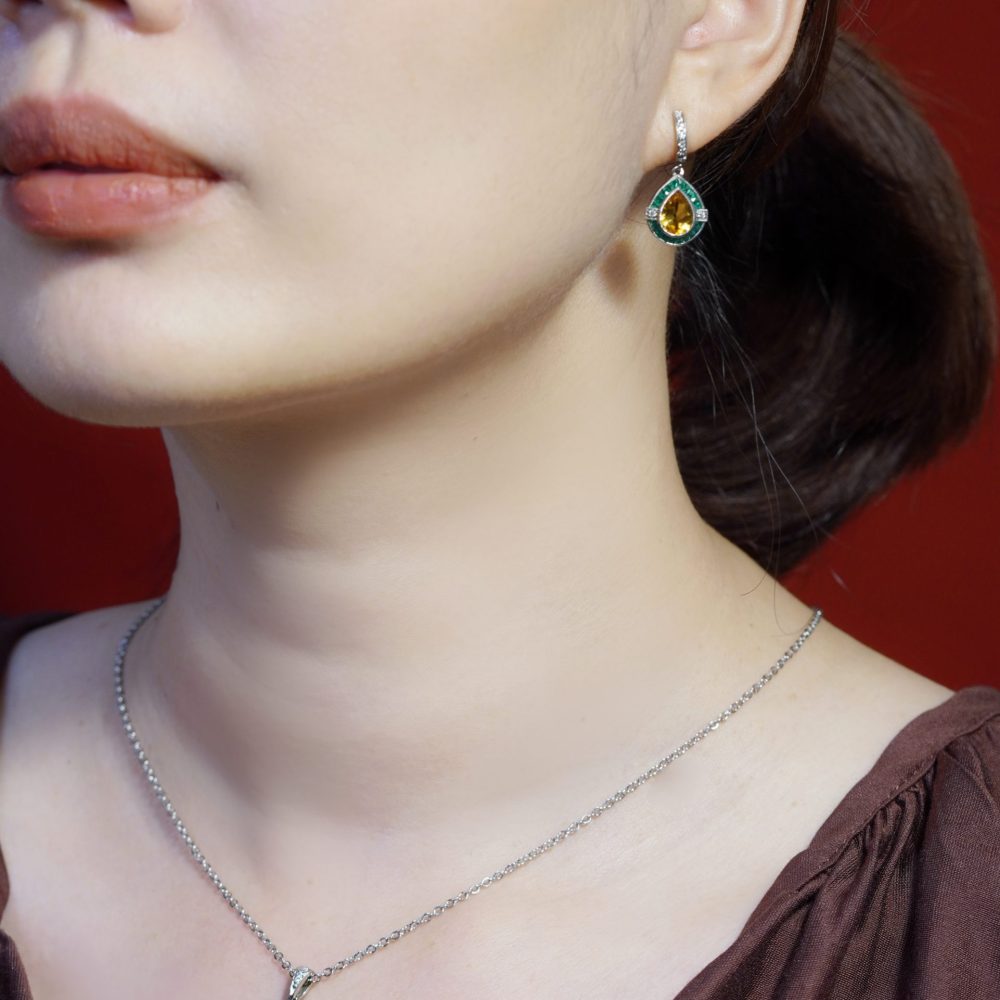
| Earrings | Strong | Occasional impact and cosmetics | Secure prongs or a fine bezel; put on after cosmetics |
| Pendant or necklace | Strong | Contact with other jewelry or hard surfaces | Maintain clearance and prevent the stone from striking the clasp |
| Brooch | Strong | Snagging or impact during handling | Use a secure frame and inspect the pin mechanism |
| Bracelet | Moderate | Frequent contact with desks and objects | Favor low-profile, protected settings |
| Occasional-wear ring | Good with care | Knocks, abrasion and exposed edges | Use a halo, bezel or well-positioned prongs |
| Daily-wear ring | Conditional | Repeated impact and gradual abrasion | Choose robust construction and accept periodic inspection |
Heat and sudden temperature change deserve attention. Extreme or rapid changes can damage gemstones, and prolonged strong light or heat may affect some citrine color. Cleaning and repair should therefore avoid unnecessary thermal exposure.
The right question is not whether citrine is “durable” in the abstract. It is whether a particular cut, size, setting and wearing pattern form a responsible system. A protected oval in a pendant faces a different life from a high-set emerald cut worn daily on the dominant hand.
How Should Citrine Be Chosen for a Fine-Jewelry Design?
Choosing citrine begins with use, not color. A jewel intended for frequent wear needs a different stone profile and setting from an occasional cocktail ring or a pendant. The process is most reliable when the design brief is established before the final stone is purchased.
What Should Be Decided First?
- Jewelry format: ring, earrings, brooch, bracelet or pendant.
- Wear frequency: daily, regular or occasional.
- Color direction: pale yellow, golden, orange or brownish orange.
- Metal relationship: contrast with white gold or continuity with yellow or rose gold.
- Scale: quiet accent, paired stones or principal center.
- Protection: bezel, halo, prong placement and height.
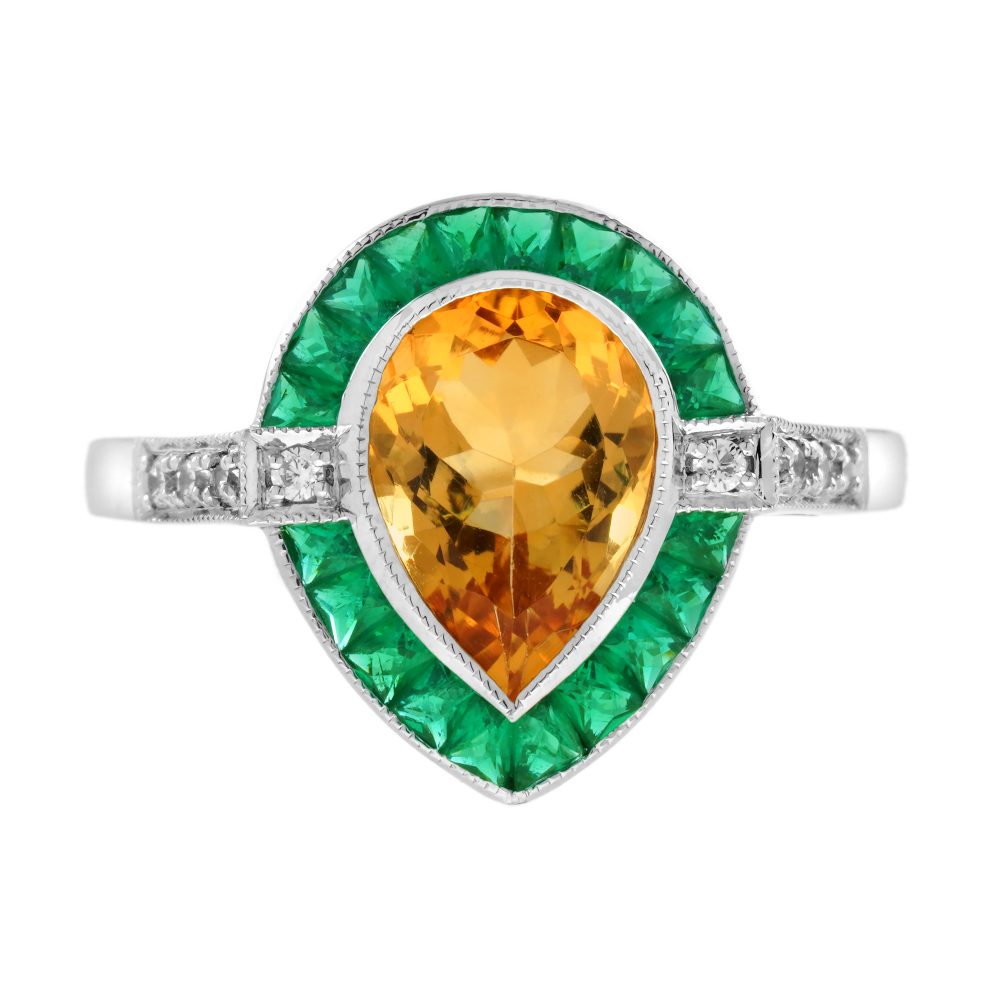
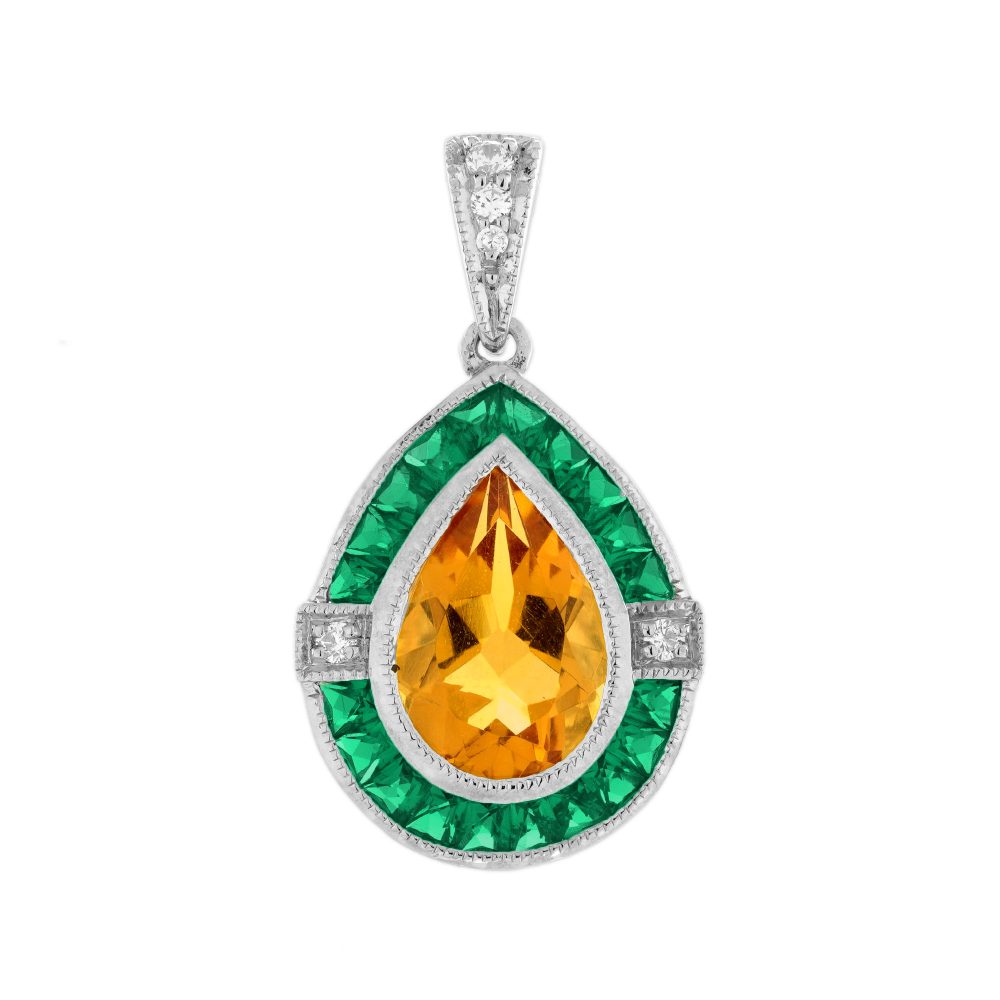
Shape changes the character of the color. A round brilliant can emphasize lively light return. An oval or cushion can support a generous center without severe corners. An emerald cut makes zoning and clarity more visible and requires disciplined proportion. A pear or marquise introduces points that should be protected.
The setting must accommodate the actual stone. Quartz may be cut in calibrated sizes, but larger citrines often have individual depth, girdle thickness and pavilion geometry. A generic mounting can leave a stone too high, place pressure on a weak point or create insufficient seat contact.
Color should be reviewed under more than one light source. Warm retail lighting can intensify orange; cool daylight may reveal brown or greenish modifiers. Photographs can also shift white balance. A considered selection asks whether the stone retains its intended identity in the environments where the jewel will be worn.
For made-to-order or bespoke work, we prefer to resolve the relationship among stone, metal and architecture as one composition. The citrine is not an interchangeable colored component. Its depth, saturation and outline establish the proportions of the whole piece.
How Does Citrine Suit Art Deco and Edwardian-Inspired Jewelry?
Citrine entered its strongest modern design moment during the first half of the twentieth century, when bold colored stones and geometric compositions suited the scale of cocktail jewelry. Its warm color works particularly well with the disciplined outlines associated with Art Deco-inspired design.
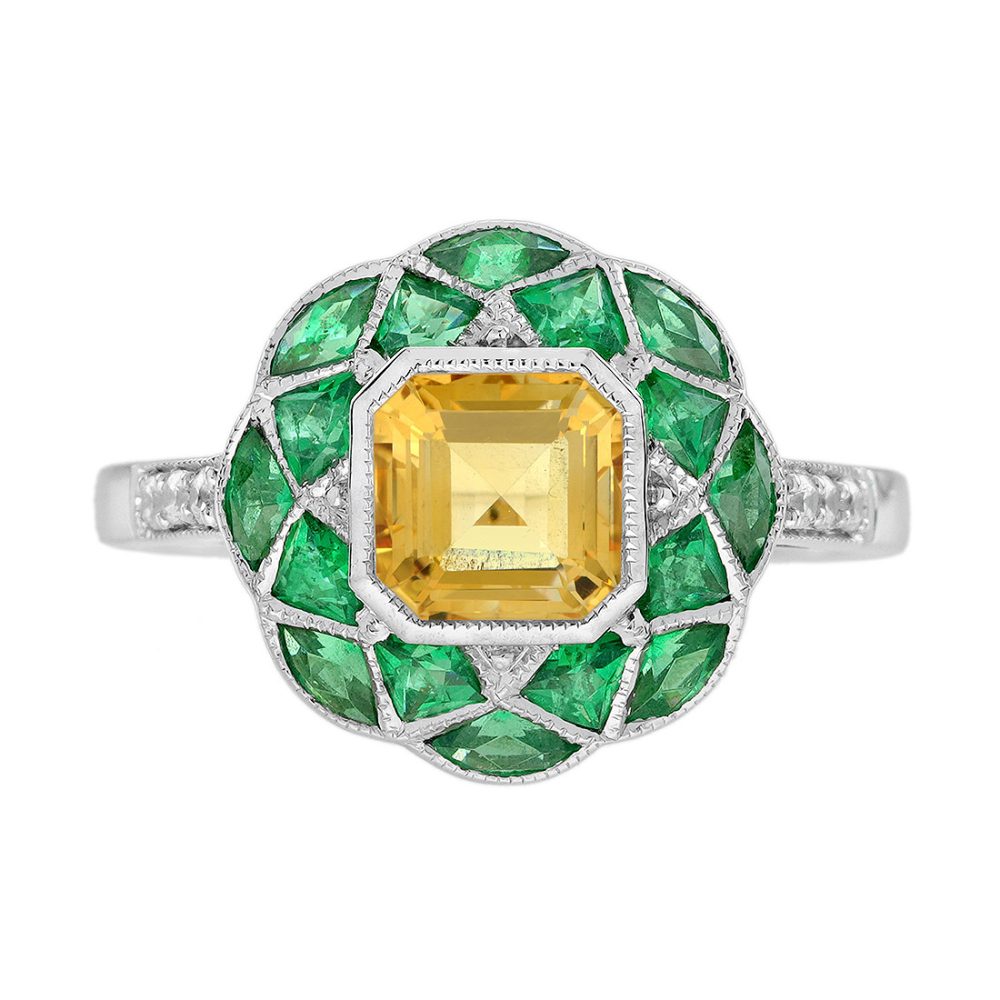
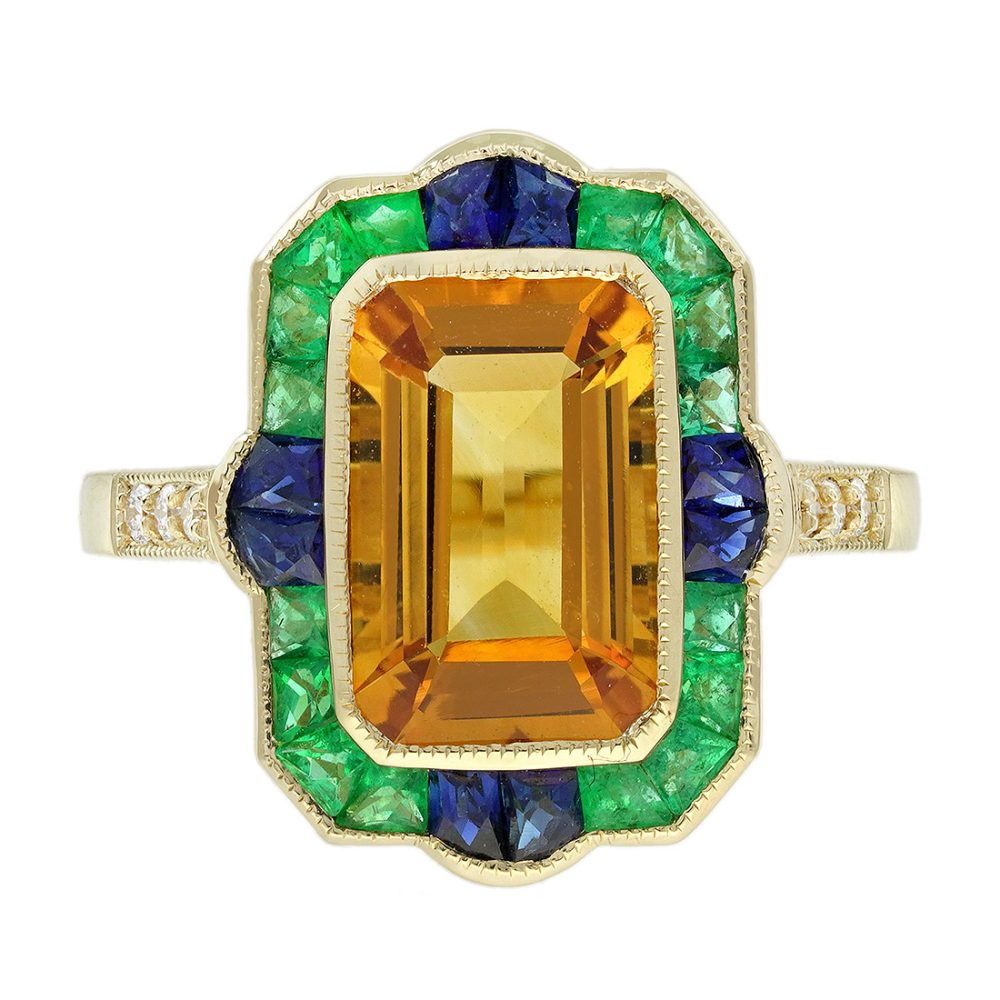
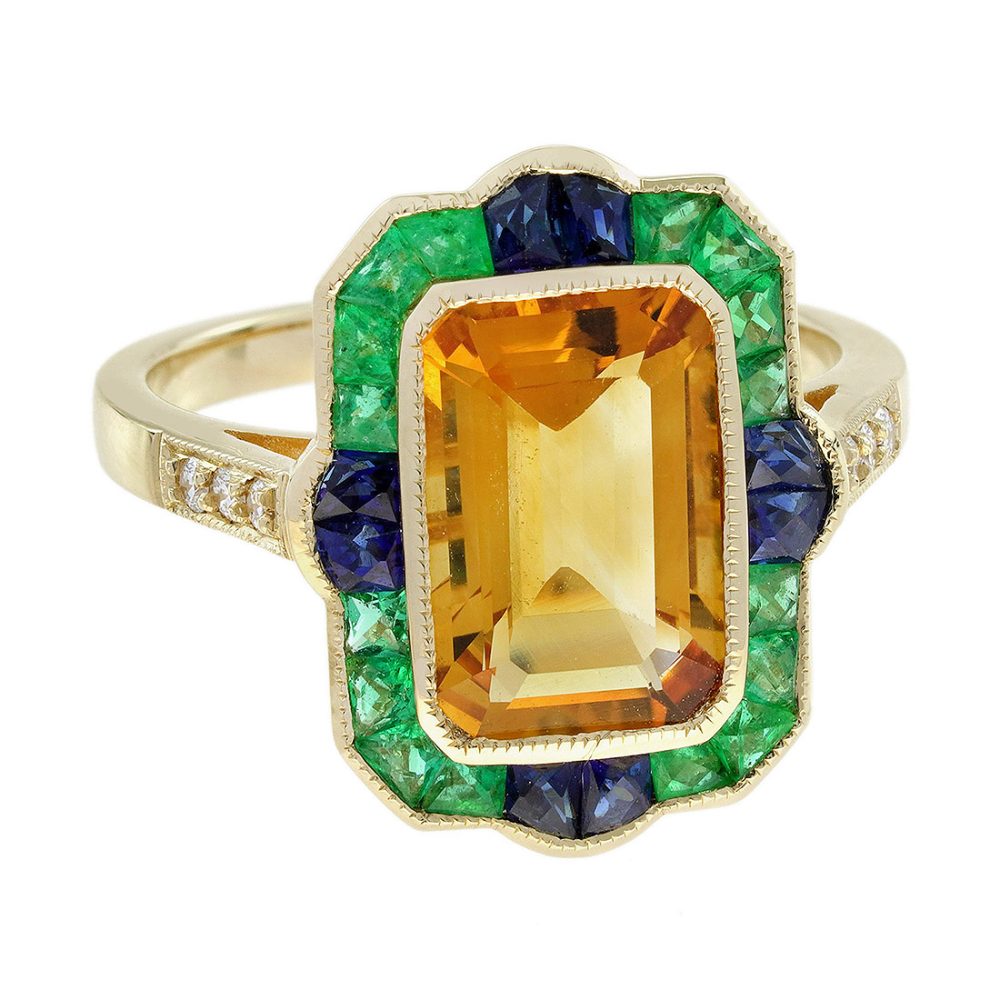
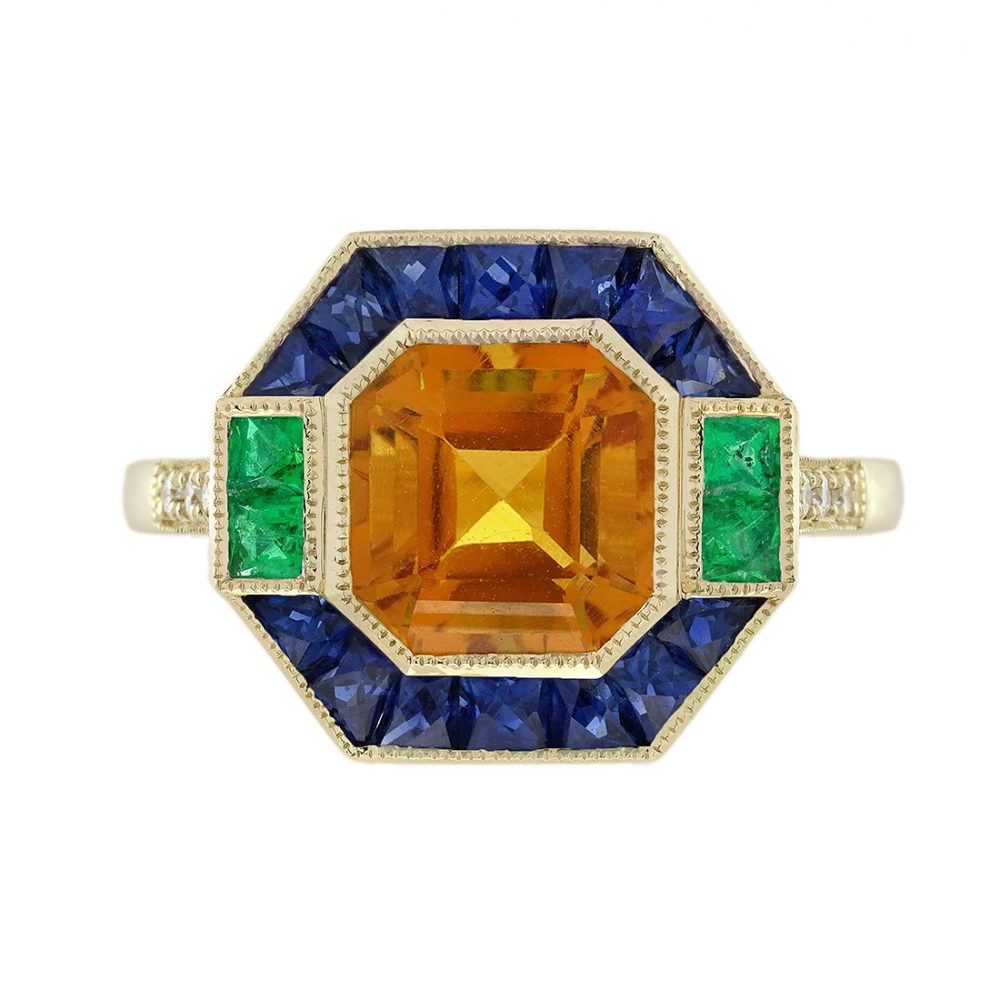
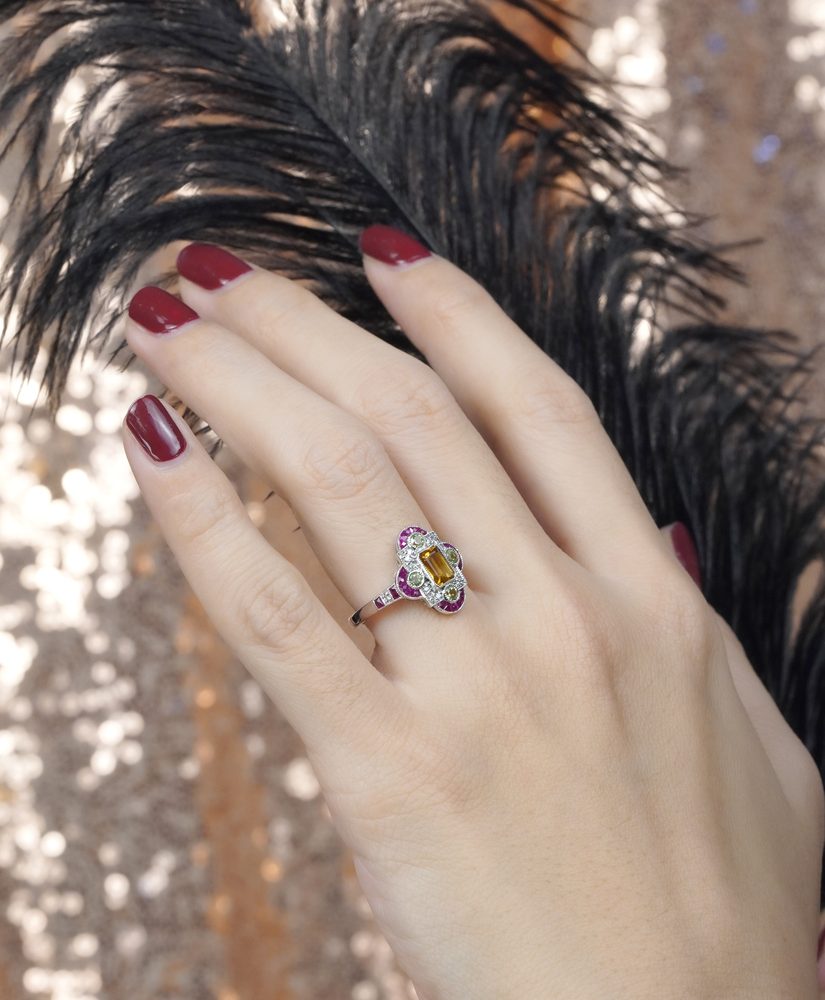
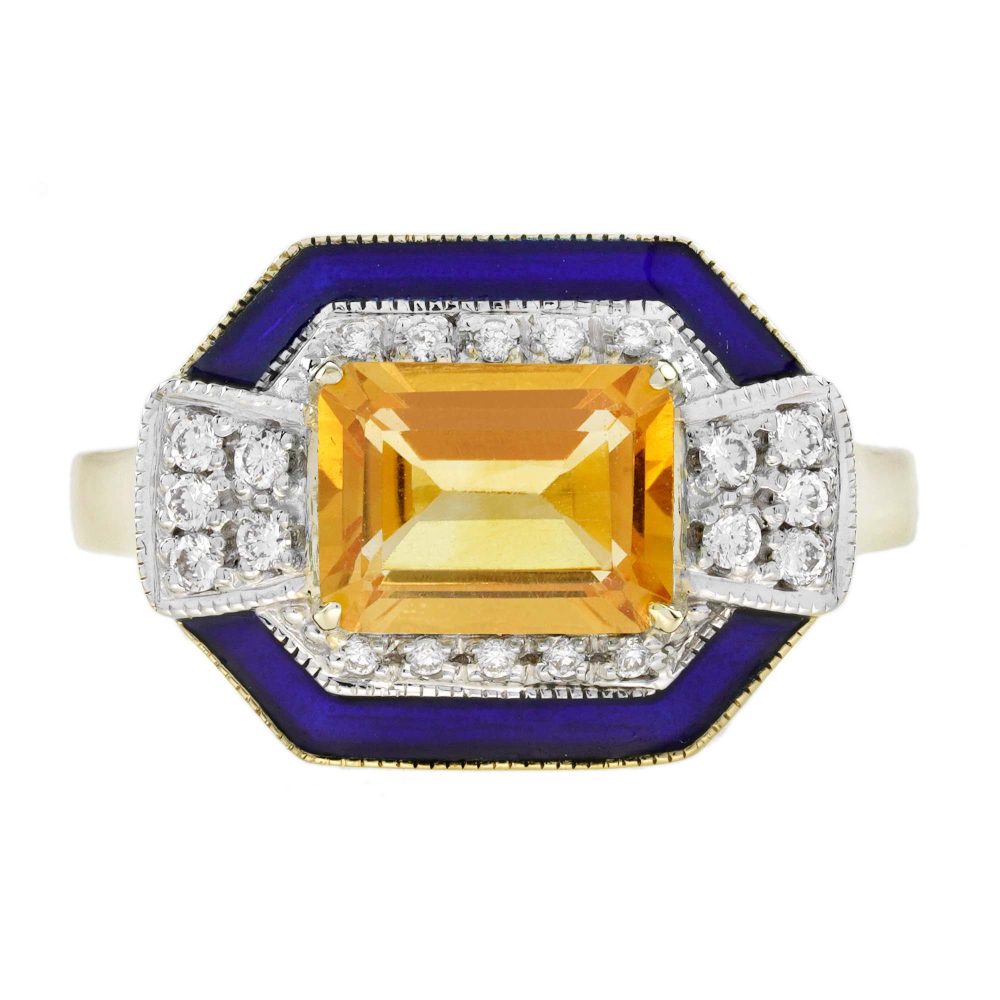
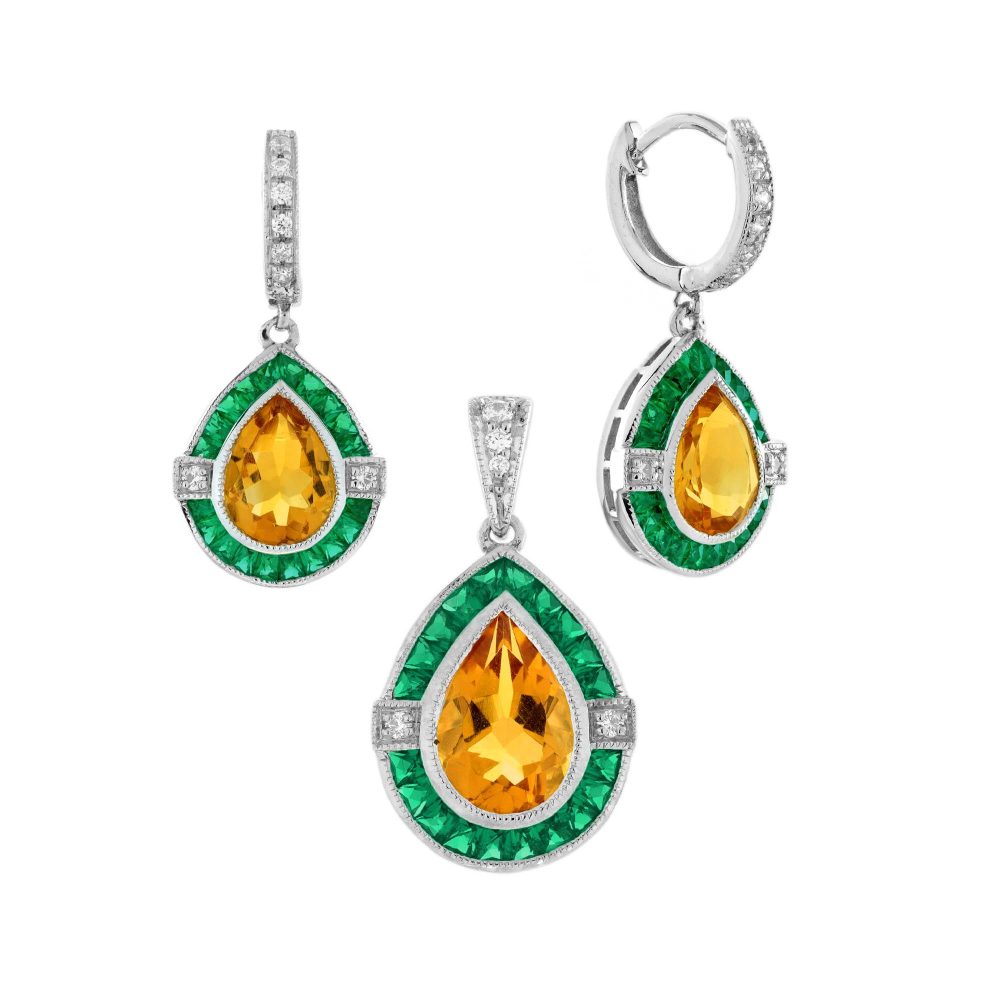
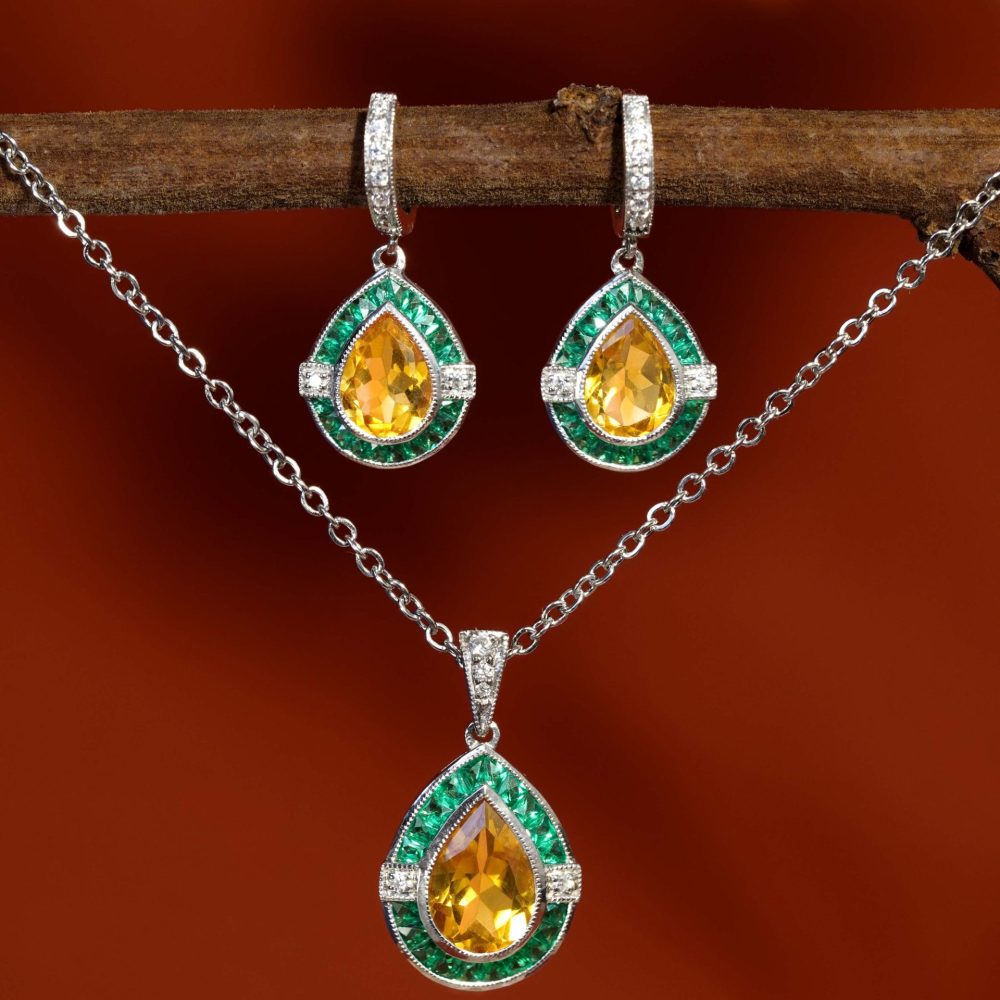
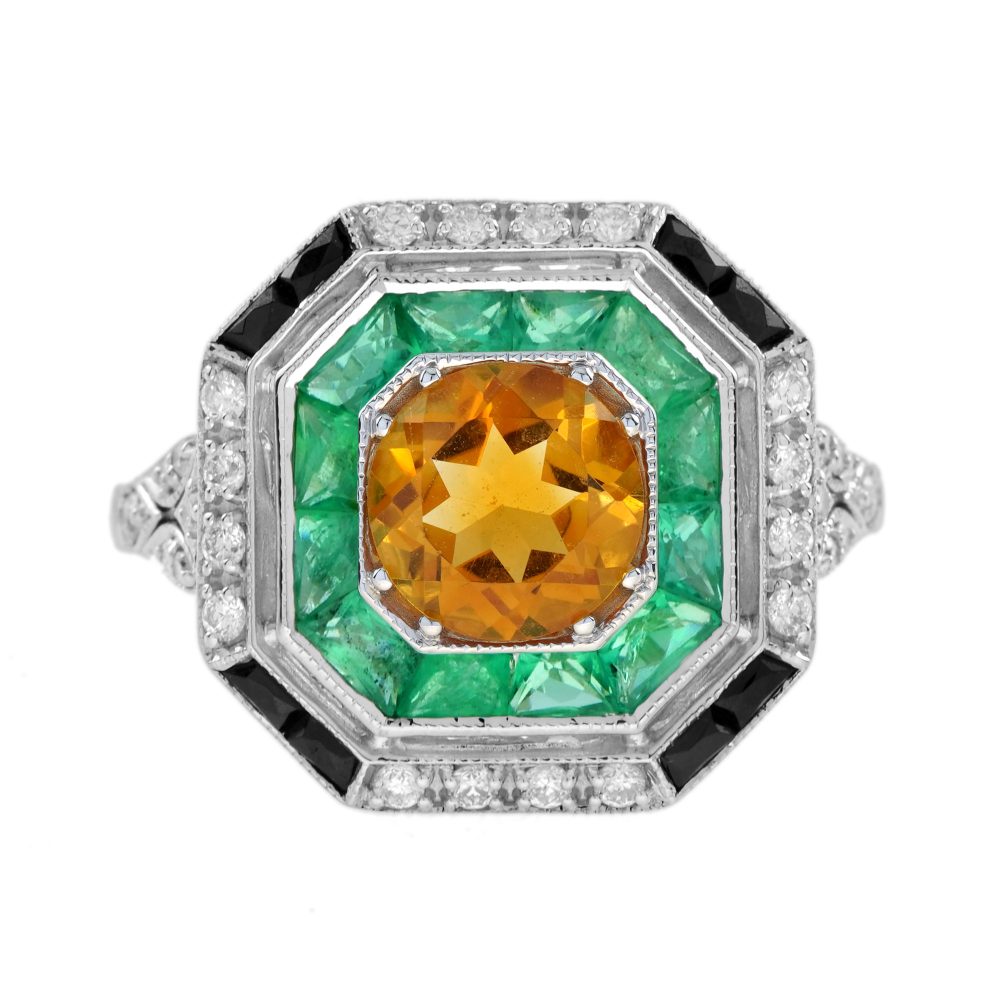
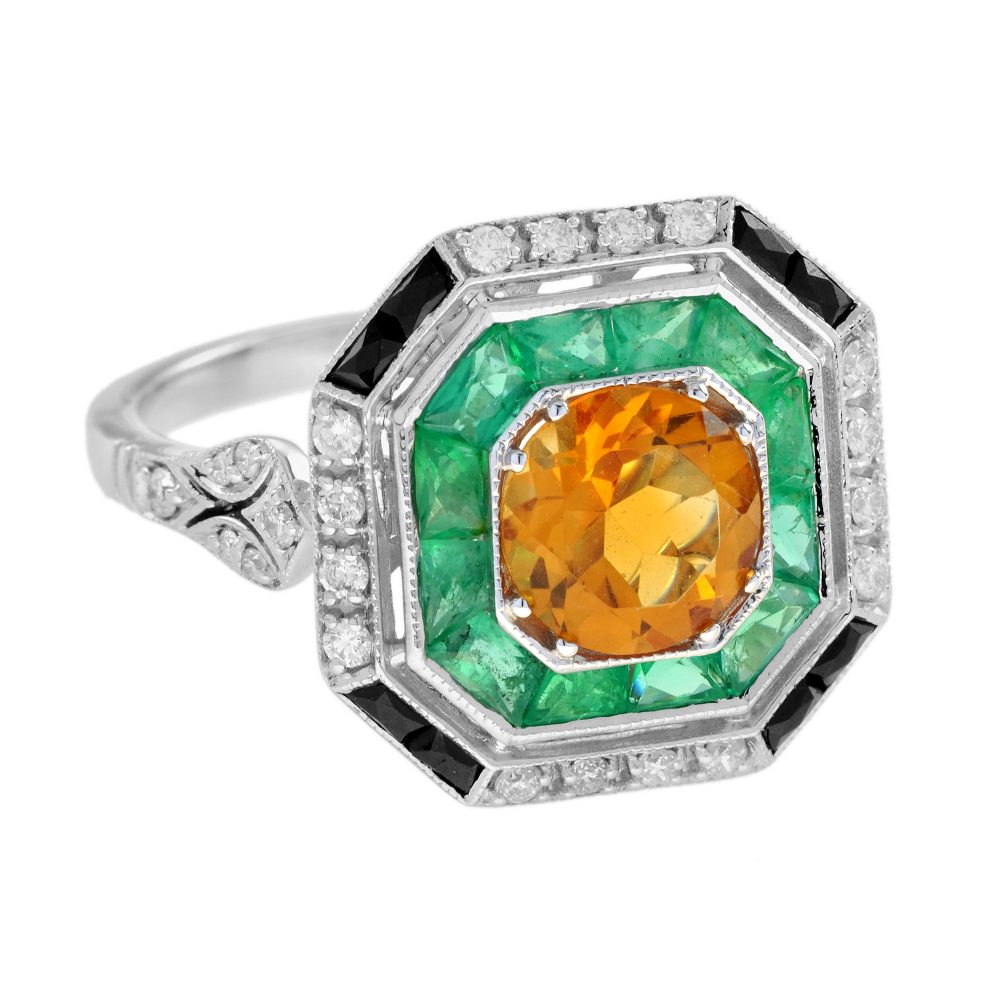
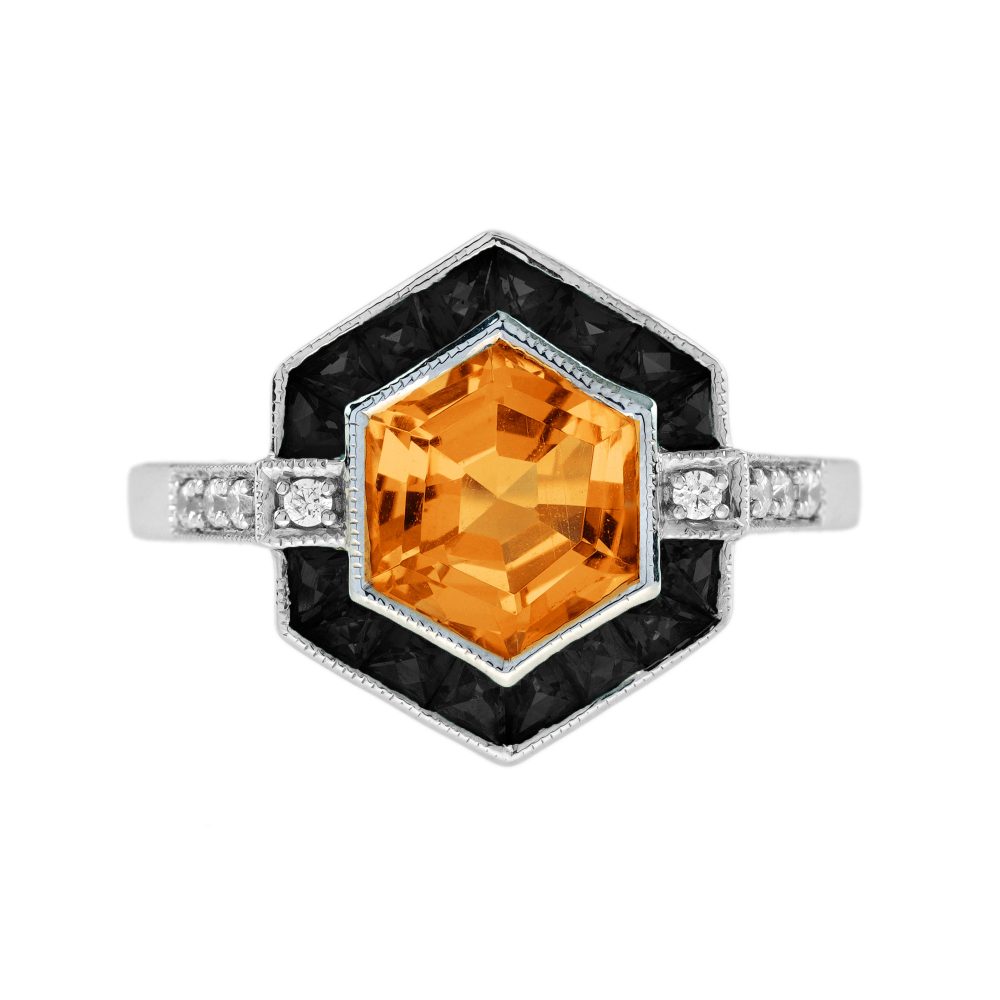
An Art Deco-inspired composition may use a step-cut or elongated citrine, linear diamond accents, repeated geometry and a strong contrast between center and frame. White gold can make the yellow stone read as a distinct field of color. Yellow gold creates a more tonal, saturated effect. Neither is inherently superior; the correct choice depends on whether contrast or continuity supports the design.
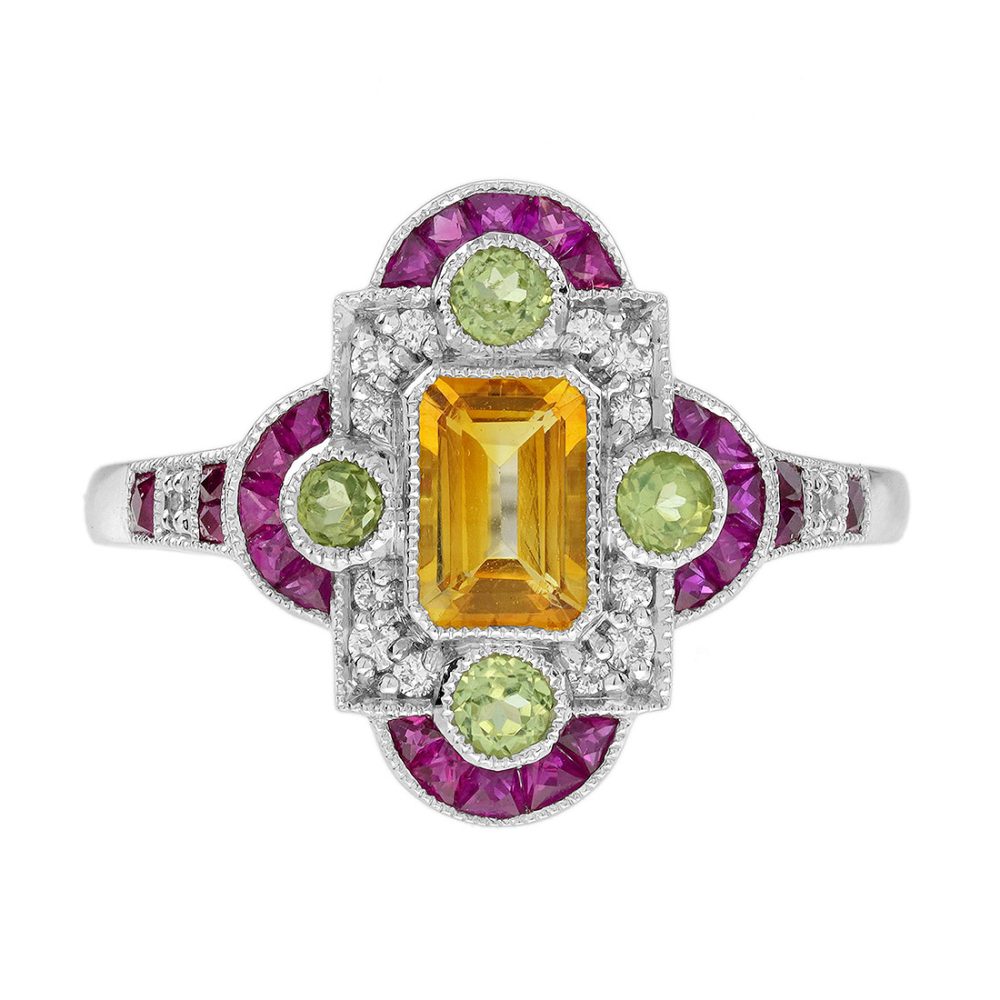
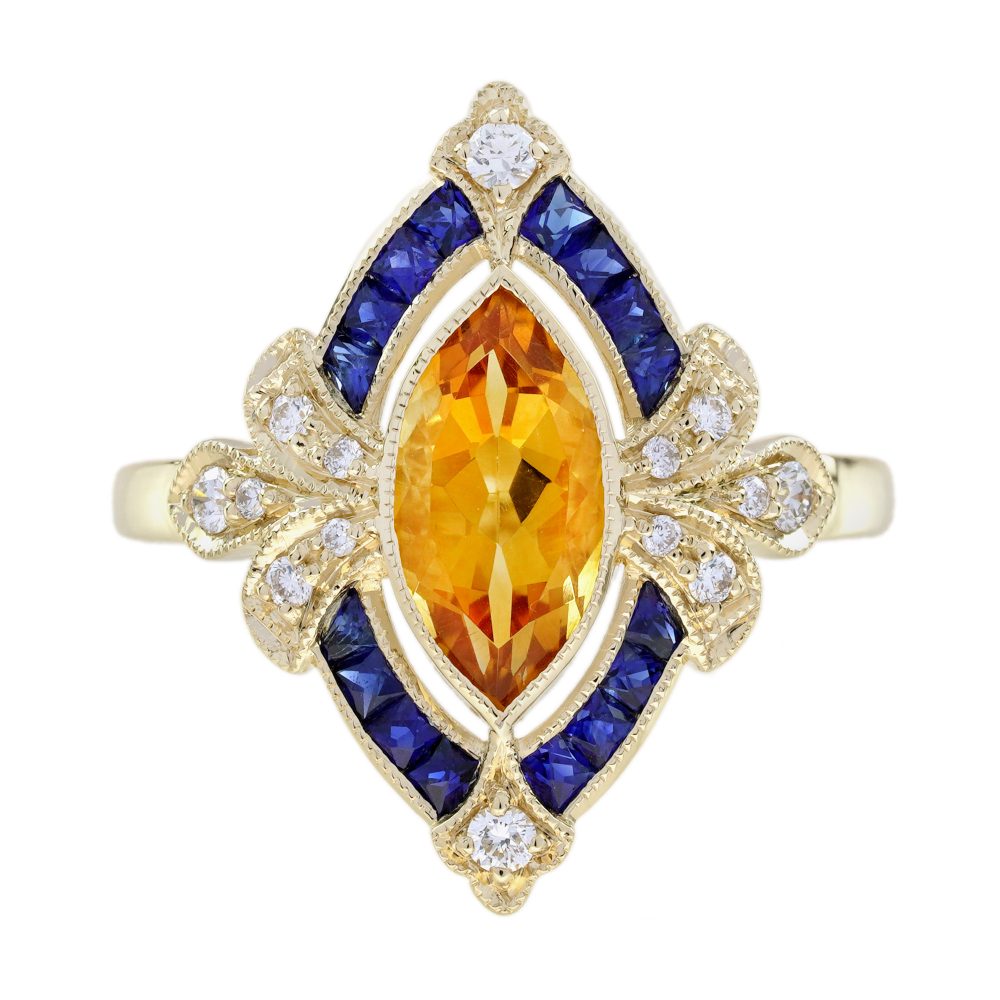
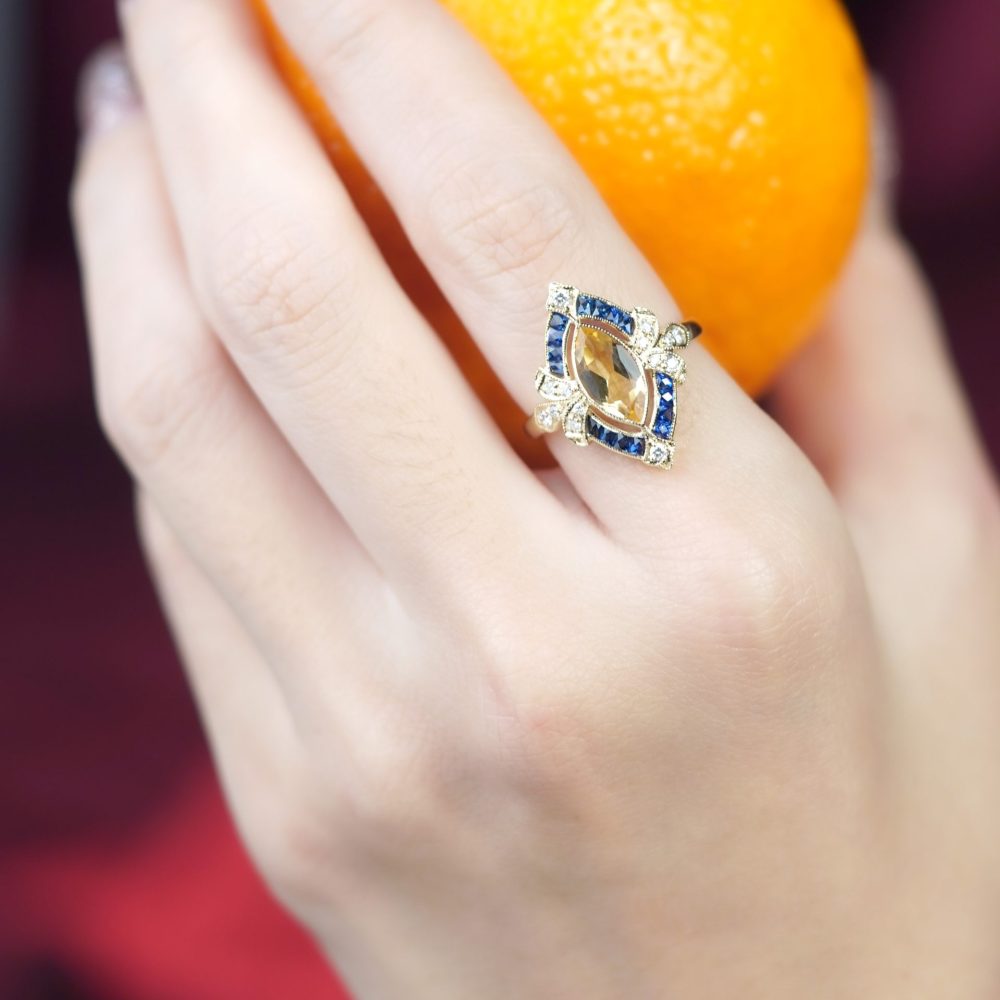
Edwardian-inspired language is lighter. Fine milgrain, lace-like openwork and smaller accent stones can give citrine a more delicate frame. The challenge is to keep ornamental detail from weakening protection. Filigree should remain structural where it meets the stone, and decorative openness should not leave the girdle unnecessarily exposed.
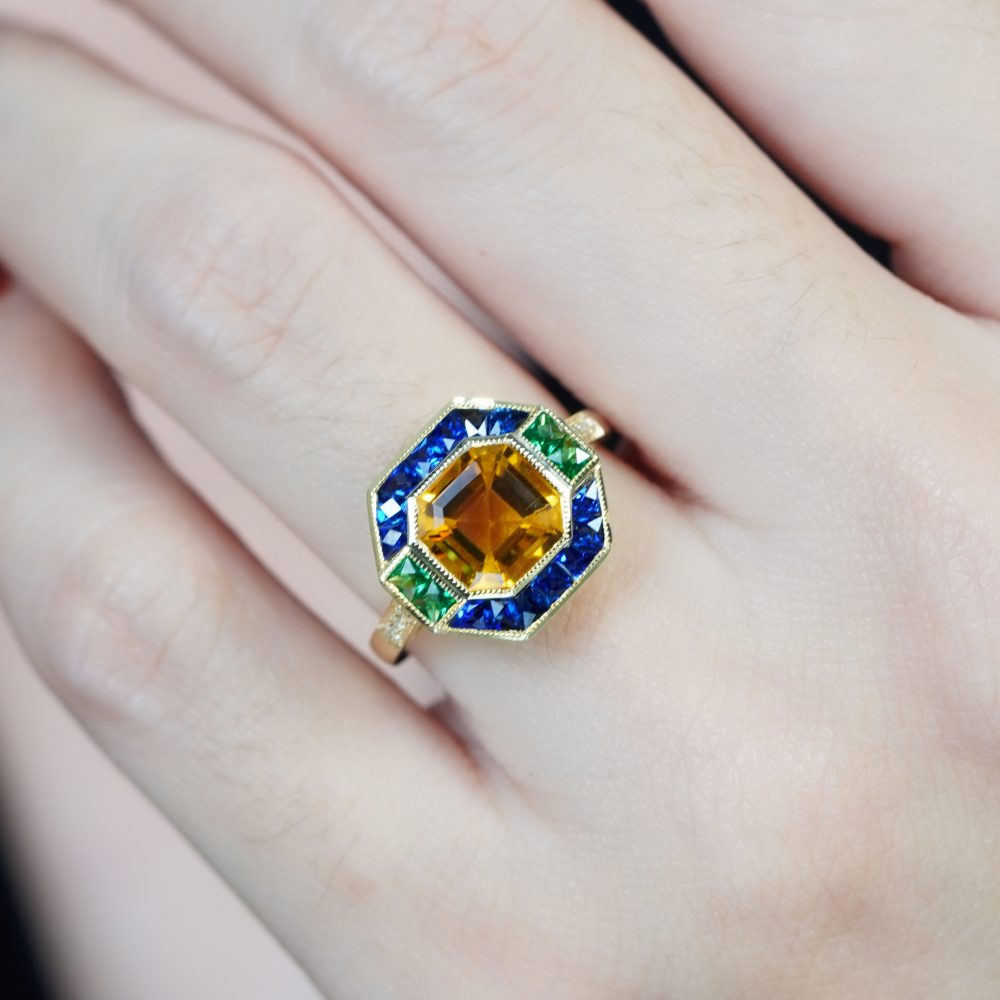
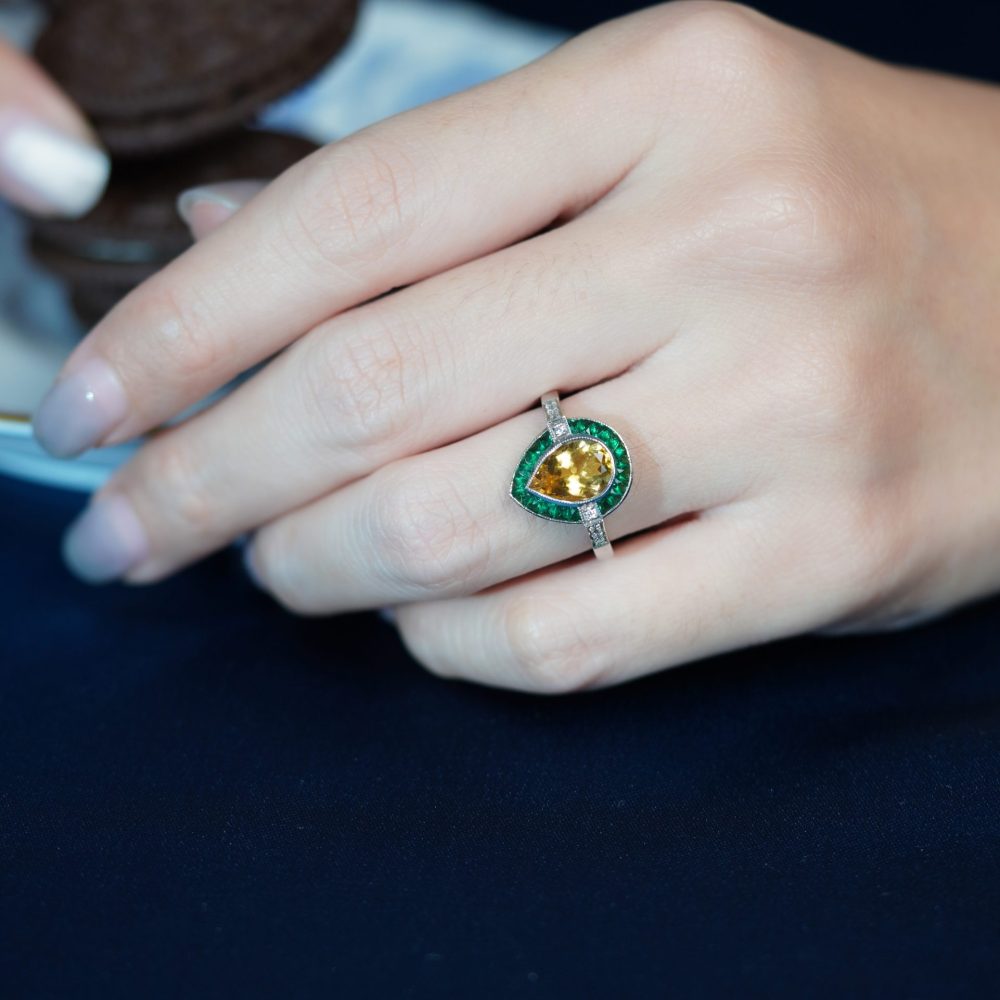
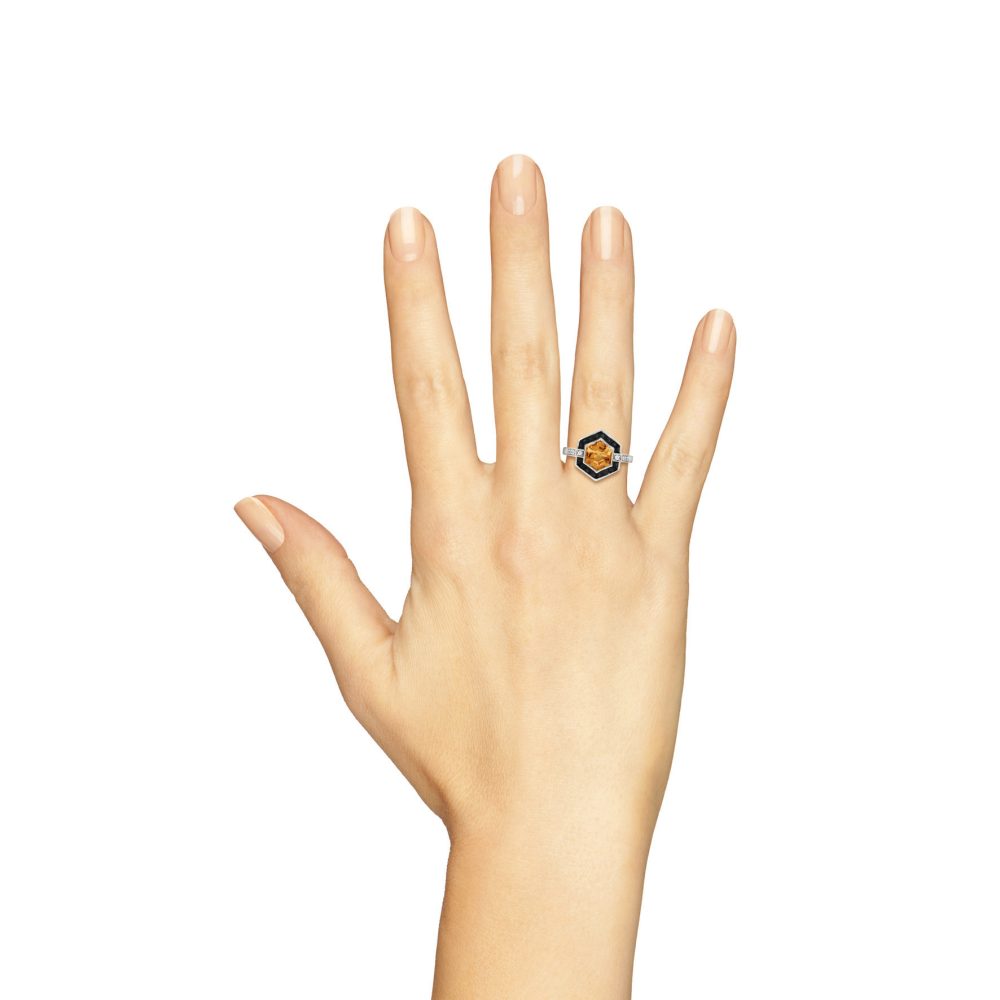
Large citrine also suits a statement ring because quartz can occur in dimensions that would be unusual or costly in many other gems. Scale should still be purposeful. A large stone with excessive depth can become uncomfortable and vulnerable when set high. Face-up spread, balance across the finger and clearance above the hand matter as much as carat weight.
Lilly M. JEWELERS produces newly made, antique-inspired jewelry. We do not describe our pieces as genuine antiques, vintage inventory or period originals. The design language may draw from Art Deco and Edwardian traditions, while the gemstone, setting and construction are made new for contemporary wear.
The most convincing historical reference comes from proportion and technique rather than surface decoration alone. A geometric gallery, controlled milgrain and correctly scaled accents can establish lineage without copying a specific old jewel or misrepresenting provenance.
How Should Citrine Jewelry Be Cleaned and Stored?
Warm water, mild soap and a soft brush are the controlled default for cleaning citrine jewelry. Rinse carefully and dry with a soft lint-free cloth. Cleaning should take place over a closed drain or a bowl, not an open sink.
The sequence matters:
- Inspect the stone, prongs, bezel and nearby joints before cleaning.
- Prepare lukewarm water with a small amount of mild soap.
- Use a soft brush beneath the setting where residue collects.
- Rinse without exposing the jewel to a sudden temperature change.
- Dry fully and check that the stone has not moved.
Steam cleaning is not recommended for citrine. Ultrasonic cleaning may be considered safe for uncomplicated quartz in some professional guidance, but it is not a universal default for a finished jewel. Fractures, unknown treatments, delicate antique-inspired construction and adjacent gemstones can change the decision. When the complete assembly is not understood, hand cleaning is more controlled.
Avoid harsh chemicals, abrasive cleaners and direct contact with household products. Put jewelry on after cosmetics, fragrance and hair products. Remove citrine rings before heavy work, exercise, gardening or any activity that can strike the stone.
Store the jewel separately in a fabric-lined compartment or soft pouch. Citrine can scratch softer gems and can itself be scratched by harder stones. Separate storage protects both surfaces. Keep the piece away from prolonged strong heat and unnecessary intense light.
Professional inspection is appropriate when a ring receives frequent wear, a prong catches fabric, the stone sounds loose or a chip appears. Cleaning restores appearance; it does not correct structural wear. Inspection protects the relationship between gem and setting that makes the jewel wearable.
What Should Be Remembered About Citrine?
Citrine is yellow-to-orange quartz and an official November birthstone alongside topaz. Its traditional meanings of warmth, optimism, generosity and abundance arise from color and culture. They are symbolic associations, not promises of medical, psychological or financial change.
Most citrine in the jewelry market is heat-treated amethyst. That practice is accepted, but accurate disclosure remains essential. Natural quartz does not automatically mean untreated quartz, and geographic origin should not be inferred from appearance or a trade color name.
At Mohs 7 with good toughness, citrine can serve rings, earrings, pendants, bracelets and brooches when the design reflects actual use. Hardness concerns scratching, while toughness concerns breaking. Protective setting, sensible height and care around impact and heat remain relevant.
Quality is a relationship among color, clarity, cut, finish, dimensions and documented treatment. The deepest orange is not automatically the best stone, and the highest carat weight is not automatically the best design. A citrine succeeds when its color remains coherent, its cut returns light evenly and its proportions belong to the jewel.
For our workshop, the strongest citrine piece aligns meaning, material and architecture. The wearer supplies the personal reason. The gem supplies color and light. The setting translates both into a newly made, antique-inspired jewel designed for responsible wear.
Sources: GIA — Citrine Gem Overview · GIA — Citrine Description · GIA — November Birthstones · GIA — Citrine Care and Cleaning · Jewelers of America — Official Birthstone List · FTC Jewelry Guides — 16 CFR Part 23


Engagement Ring

Black Friday 2026
Frequently Asked Questions About Citrine Meaning
What does citrine mean?
Citrine traditionally symbolizes warmth, optimism, generosity and abundance. These are cultural associations inspired by its yellow-to-orange color, not scientifically proven medical, psychological or financial effects.
Is citrine the only November birthstone?
No. Citrine and topaz are both official November birthstones on the modern US list maintained by Jewelers of America.
Is most citrine heat-treated?
Yes. Much of the citrine in the jewelry market is produced by heating amethyst. The result remains natural quartz, but natural does not mean untreated, so known treatment should be accurately disclosed.
Is citrine suitable for everyday jewelry?
Citrine measures Mohs 7 and has good toughness, so it suits many jewelry formats with sensible care. Daily-wear rings still benefit from protective settings, moderate height and removal during activities that may cause impact or abrasion.
How should citrine jewelry be cleaned?
Clean citrine with lukewarm water, mild soap and a soft brush, then rinse and dry carefully. Avoid steam, harsh chemicals, abrasives and sudden temperature changes. Use professional advice before ultrasonic cleaning a finished jewel with unknown treatments or delicate construction.