
Style & History
Art Deco vs Edwardian Jewelry: How to Tell the Difference

Key Takeaways: Art Deco vs Edwardian Jewelry
- Art Deco vs Edwardian jewelry comes down to one contrast: lace versus geometry. Edwardian design imitated the look of fine lace in platinum filigree; Art Deco replaced that softness with hard-edged geometric symmetry.
- The eras do not overlap cleanly. Edwardian runs roughly 1901–1915; Art Deco roughly 1920–1935. A transitional period in the late 1910s blends elements of both.
- Stone cutting is the fastest tell. Soft, uneven old mine and rose-cut diamonds point to Edwardian hand-cutting; crisp, precision calibré-cut colored stones point to Art Deco.
- Millegrain edging appears in both periods, so on its own it does not distinguish them — look at the overall shape and motif instead.
- We make new pieces inspired by both styles — never sold as antique. A Lilly M. piece in either style is new work, honestly described as inspired by the era, not a period find.
[rank_math_contents]
Art Deco vs Edwardian Jewelry: What Is the Difference?
Art Deco vs Edwardian jewelry is a contrast between two back-to-back but distinct early-20th-century styles. Edwardian jewelry (roughly 1901–1915) used platinum filigree to imitate the delicate look of lace, with flowing, nature-inspired motifs. Art Deco (roughly 1920–1935) reacted against that softness with bold geometric lines, symmetry, and precision-cut stones. Both favored platinum, but used it toward opposite visual ends — one soft and lacy, the other hard-edged and architectural.
Art Deco vs Edwardian Jewelry at a Glance
| Feature | Edwardian (c. 1901–1915) | Art Deco (c. 1920–1935) |
|---|---|---|
| Overall look | Lace-like, delicate, flowing | Geometric, bold, symmetrical |
| Metal | Platinum, fine open filigree | Platinum, solid geometric settings |
| Motifs | Garlands, bows, ribbons, floral sprays | Chevrons, sunbursts, Egyptian/Asian motifs |
| Diamond cuts | Old mine, old European, rose cuts | Old European transitioning to modern cuts |
| Colored stones | Used sparingly, often as accents | Calibré-cut, used for bold color-blocking |
| Construction | Open, lace-like filigree, millegrain edges | Geometric lattice, millegrain edges |
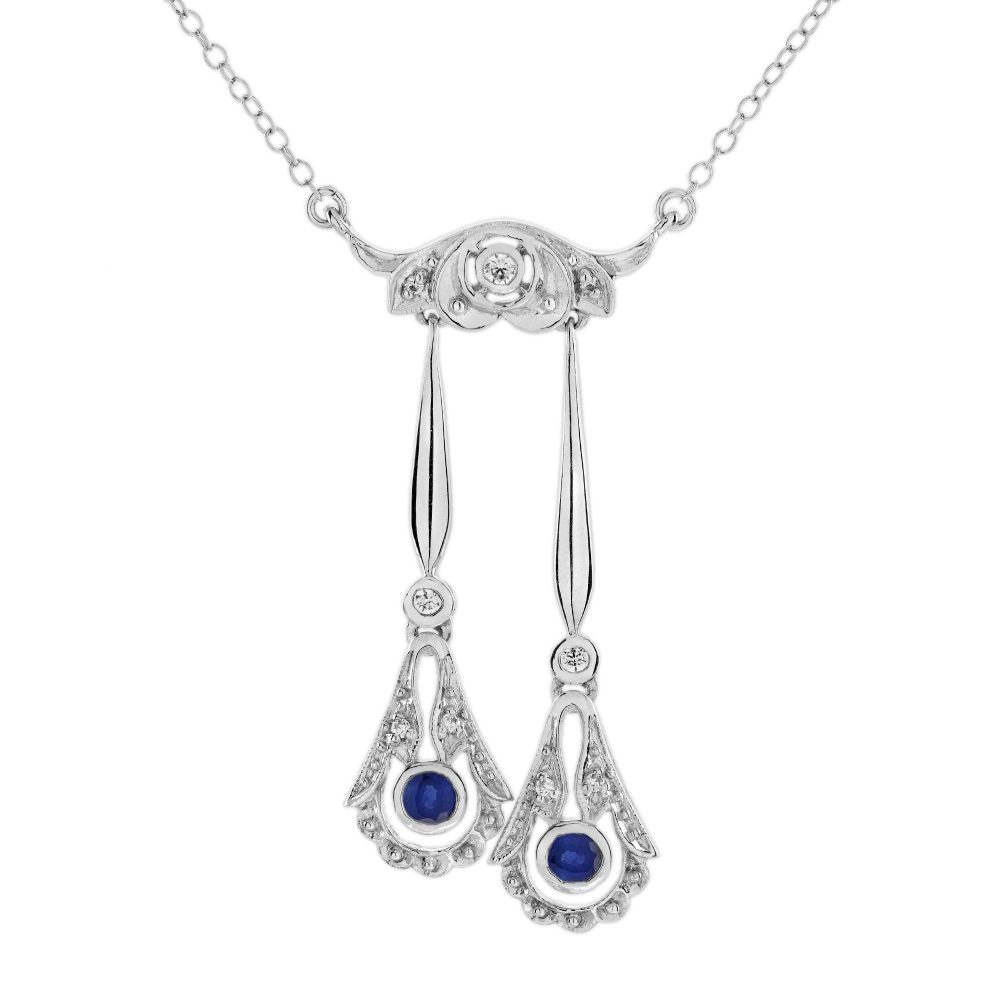
| Common pieces | Lavaliere necklaces, bar pins, garland tiaras | Cocktail rings, long pendants, bracelet lines |
When Did Each Style Actually Overlap?
Edwardian jewelry is named for King Edward VII’s reign (1901–1910) but is generally dated roughly 1901 to 1915, since the style continued past his death until World War I disrupted both materials supply and the social world the jewelry served. Art Deco followed roughly five years later, taking hold through the 1920s and fading by the mid-1930s.
Pieces from the late 1910s often blend both languages — lace-like filigree starting to straighten into geometric lines — so art deco vs edwardian jewelry is not always a clean either/or question for a piece made right at that transition. Most pieces, however, sort clearly into one style or the other once you know what to look for.
The difference between art deco and edwardian jewelry dating also shows up in the social context each style served: Edwardian pieces were made for a world of formal daywear and elaborate evening dress, with garland tiaras and lavaliere necklaces suited to that; Art Deco emerged alongside a faster, more modern social life — shorter hemlines, cocktail hour, travel — and its jewelry, bolder and more wearable day-to-night, reflects that shift directly.
How Do the Motifs Differ?
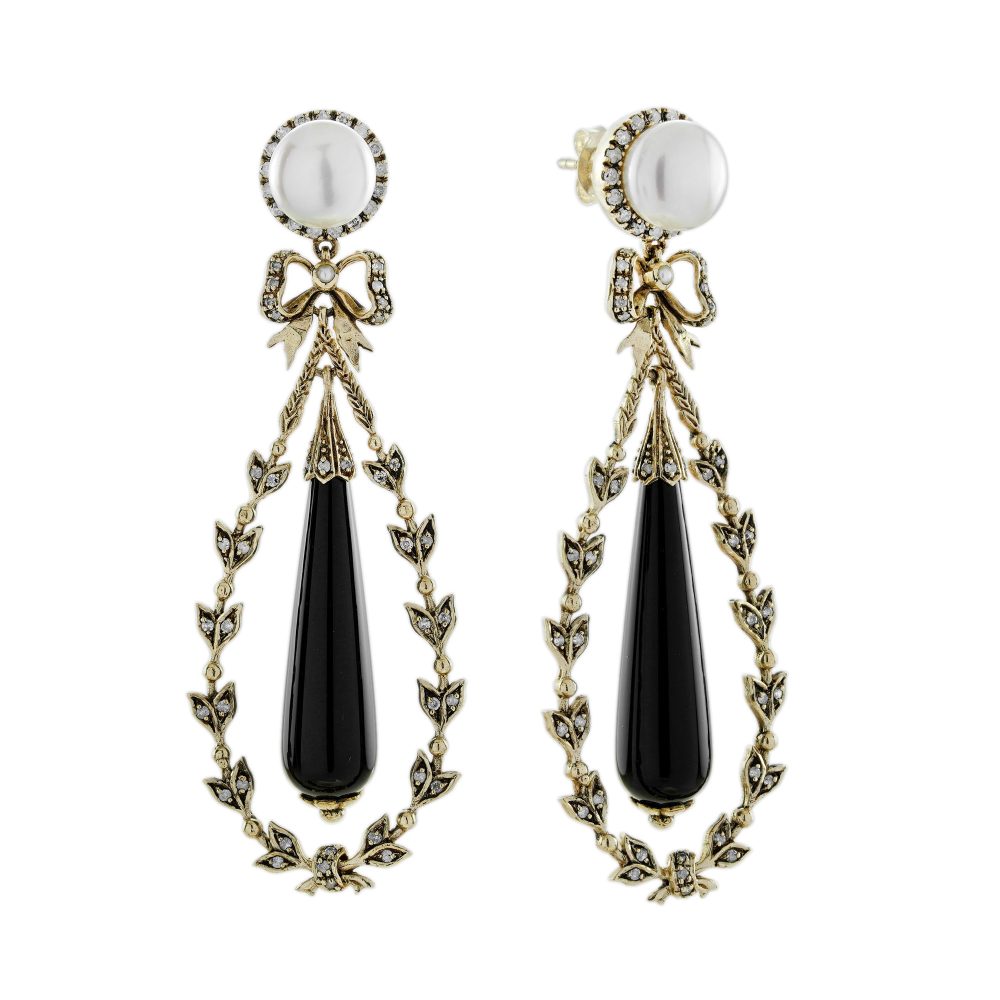
Edwardian motifs drew directly from nature and textiles: garlands, bows, ribbons, laurel wreaths, and floral sprays, all rendered as flowing, curved lines in open platinum work. The goal was for the metal itself to read as fabric or lace, as delicate and soft-edged as the fashion of the period.
Art Deco motifs went the opposite direction: chevrons, sunbursts, stepped “skyscraper” forms, and motifs borrowed from Egyptian and East Asian art, all reinterpreted through straight lines and repeated geometric units. Comparing art deco vs edwardian motifs side by side is often the fastest way to place an unfamiliar piece, since the visual language is so different even when the metal and general quality level are similar.
A useful way to picture it: an Edwardian garland motif curves and loops the way a real ribbon would if laid across the piece, while an Art Deco sunburst radiates outward in perfectly straight, evenly spaced lines. One reads as drawn freehand from nature; the other reads as drafted with a ruler.
How Does the Metalwork Differ?
Both styles relied heavily on platinum, newly workable in jewelry at the start of the 20th century, but used its strength toward different ends. Edwardian jewelers used platinum’s strength to create extremely fine, open, lace-like filigree — thin wirework and tiny pierced openings meant to look woven rather than metal at all.
Art Deco jewelers used that same structural strength for a different purpose: bold, geometric lattice settings with clean negative space, built for visual impact rather than textile-like delicacy. Millegrain — a fine beaded edge along the metal — appears in both periods and does not, by itself, distinguish them; it is the overall shape built around it that tells Edwardian from Art Deco.
This is one of the more technical differences between art deco and edwardian jewelry construction: Edwardian filigree is built from many thin, curved wire elements joined at intersections, while Art Deco lattice work favors fewer, straighter, more substantial elements arranged symmetrically — both are skilled platinum work, but the underlying construction logic is almost opposite.
Related: Our Guarantee
How Do the Stone Cuts Differ?
Stone cutting is one of the clearest, most reliable ways to tell art deco vs edwardian jewelry apart. Edwardian pieces typically use old mine cut, old European cut, or rose-cut diamonds — all hand-cut, with soft, slightly uneven facets and a warmer, less brilliant sparkle than a modern cut, reflecting the hand tools available at the time.
Art Deco pieces show a transition: early Art Deco jewelry still used old European cuts, but the period also popularized calibré-cutting — colored stones custom-shaped to fit precisely into a geometric pattern, edge to edge with their neighbors. That precision-fitted colored stonework, largely absent from Edwardian pieces, is one of the strongest single indicators of Art Deco construction.
Hold a loupe to the facets if one is available: old mine and rose cuts show slightly irregular facet junctions and a boxy, high-crowned profile, since each stone was shaped by eye rather than machine-guided. Calibré-cut colored stones, by contrast, show crisp, perfectly matched edges cut specifically to a template, because the whole point of calibré-cutting was a precise fit against neighboring stones and metal — a difference between art deco and edwardian jewelry that is easy to see once you know to look for it, even without a jeweler’s training.
What Is the Fastest Way to Tell Them Apart?
If only one glance is available, shape is the fastest signal: curved, flowing, lace-like outlines point to Edwardian; straight-edged, symmetrical, geometric outlines point to Art Deco. A second-fastest check is color — heavy, bold color-blocking from calibré-cut stones is an Art Deco signature that Edwardian pieces rarely show, since Edwardian jewelry favored diamonds with only sparing use of colored accents.
For a more confident answer, combine shape, motif, and stone cutting together rather than relying on any single trait, since a few pieces — particularly from the transitional late 1910s — borrow elements from both. Treat the comparison like a short checklist rather than a single snap judgment, and the art deco vs edwardian jewelry question gets much easier to answer with confidence.
It helps to practice on pieces you already know are one style or the other before judging an unfamiliar one. Once the lace-versus-geometry contrast feels obvious on a few confirmed examples, spotting it in a new piece — a ring at an estate sale, a brooch inherited from a relative — becomes much faster, because the eye starts to recognize the pattern rather than checking each feature one at a time.
Related: Our Guarantee
Can Hallmarks Help Date a Piece?
Yes, with care. Platinum hallmarking became more standardized through the early 20th century, so a mark consistent with period purity standards and a maker’s mark that can be traced to a known workshop active in a specific window both help narrow a date. Neither is foolproof on its own — hallmarks can be worn illegible, reused, or in rare cases altered — which is why the difference between art deco and edwardian jewelry is best confirmed by combining hallmarks with the style, construction, and stone-cutting signals already covered.
A reputable appraiser or estate jeweler, ideally one with specific experience in early-20th-century pieces, is the right resource for a confident dating opinion on a specific piece, rather than relying on any single feature in isolation.
Provenance documents — an old receipt, a family record, or a prior appraisal — can help too, when they exist, but most pieces reach a new owner with none of that paperwork. In practice, style, construction, stone cutting, and hallmarks together give a reliable answer for art deco vs edwardian jewelry even with no paper trail at all.
Does Lilly M. Make Edwardian-Style Jewelry Too?
Yes. Our work draws on both Edwardian and Art Deco design, and the same honesty applies to both: every piece is newly made, by hand, in solid gold or platinum, and is never represented as a period original or antique, whichever style it is inspired by. We describe our pieces as Edwardian-inspired or Art Deco-inspired, which is an accurate description of new work that honors a historical style.
Understanding art deco vs edwardian jewelry characteristics helps when choosing between the two for a new piece, too — lace-like Edwardian filigree suits a softer, more romantic taste, while Art Deco geometry suits a bolder, more architectural one, and neither is more “correct” than the other.
Related: Bespoke & Personalization
What Should You Remember About Art Deco vs Edwardian Jewelry?
Art Deco vs Edwardian jewelry comes down to lace versus geometry: Edwardian’s flowing, nature-inspired filigree against Art Deco’s bold, symmetrical lines, with stone cutting as the fastest reliable tell between hand-cut Edwardian diamonds and Art Deco’s precision calibré-cut color work. The two styles sit back-to-back in history, roughly 1901–1915 and 1920–1935, with a short transitional overlap in between.
If you remember only one shortcut for the difference between art deco and edwardian jewelry, make it this: look at the outline first, then the stones. A curved, lace-like outline with soft-cut diamonds is Edwardian; a straight-edged, symmetrical outline with crisply fitted colored stones is Art Deco. Hallmarks and construction details are useful confirmation, but shape and stone cutting will correctly sort most pieces on their own.
We make new pieces inspired by both, in solid gold and platinum, and are always upfront that the design language is historical even though the piece itself was made recently, by us.
Sources: GIA — Art Deco and Edwardian Jewelry History · The Metropolitan Museum of Art — Decorative Arts Reference
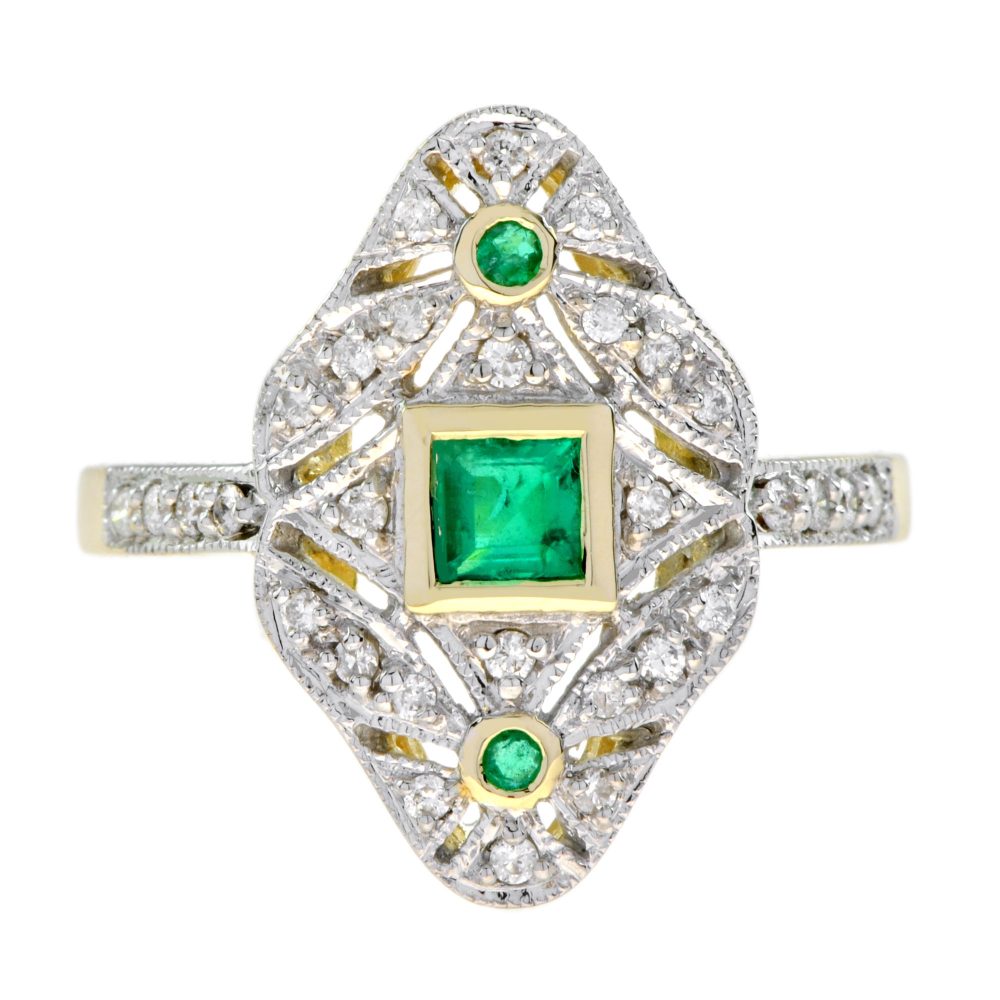
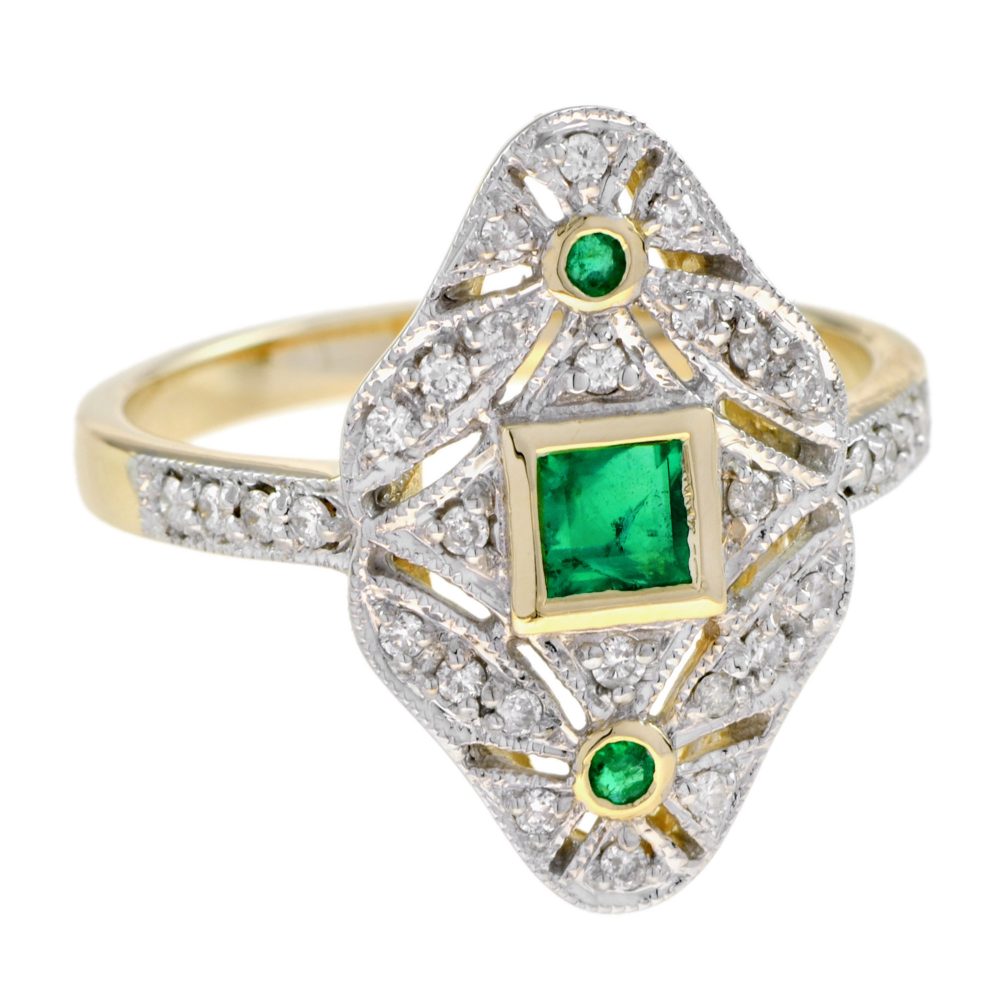
Cocktail Ring
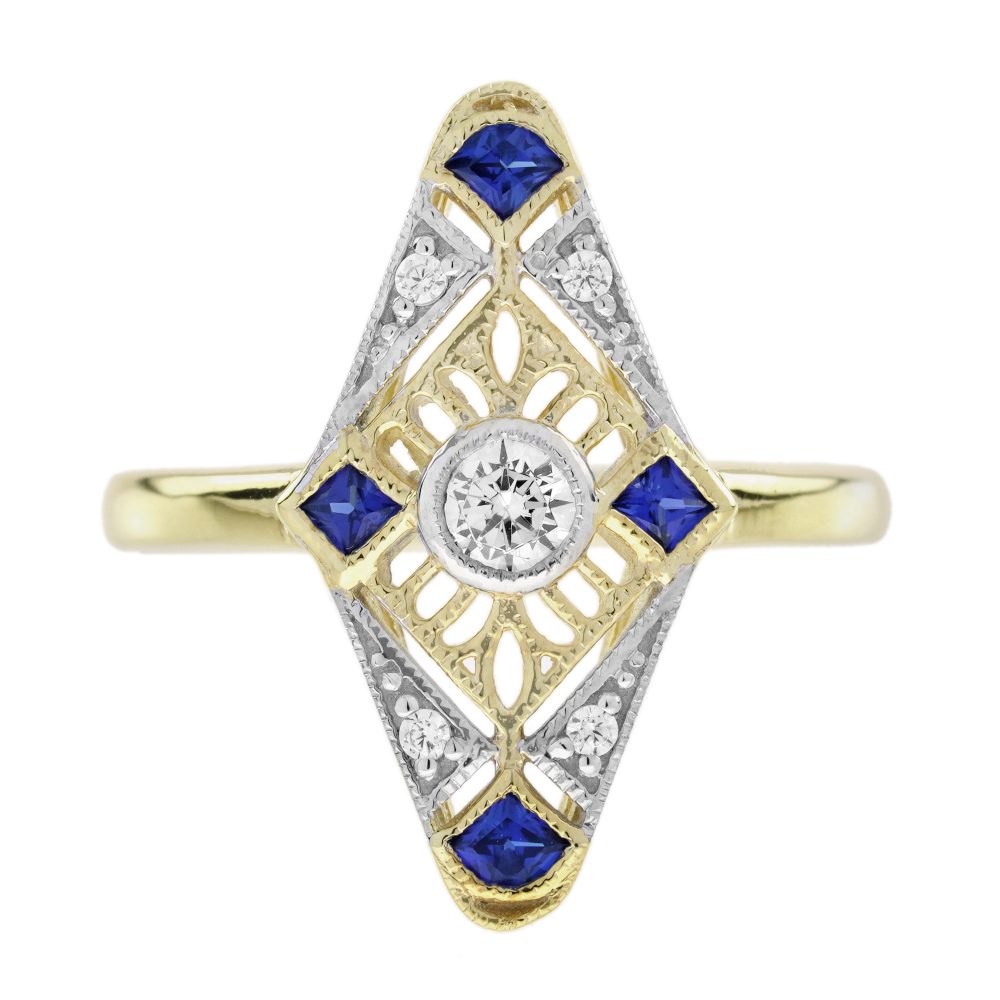
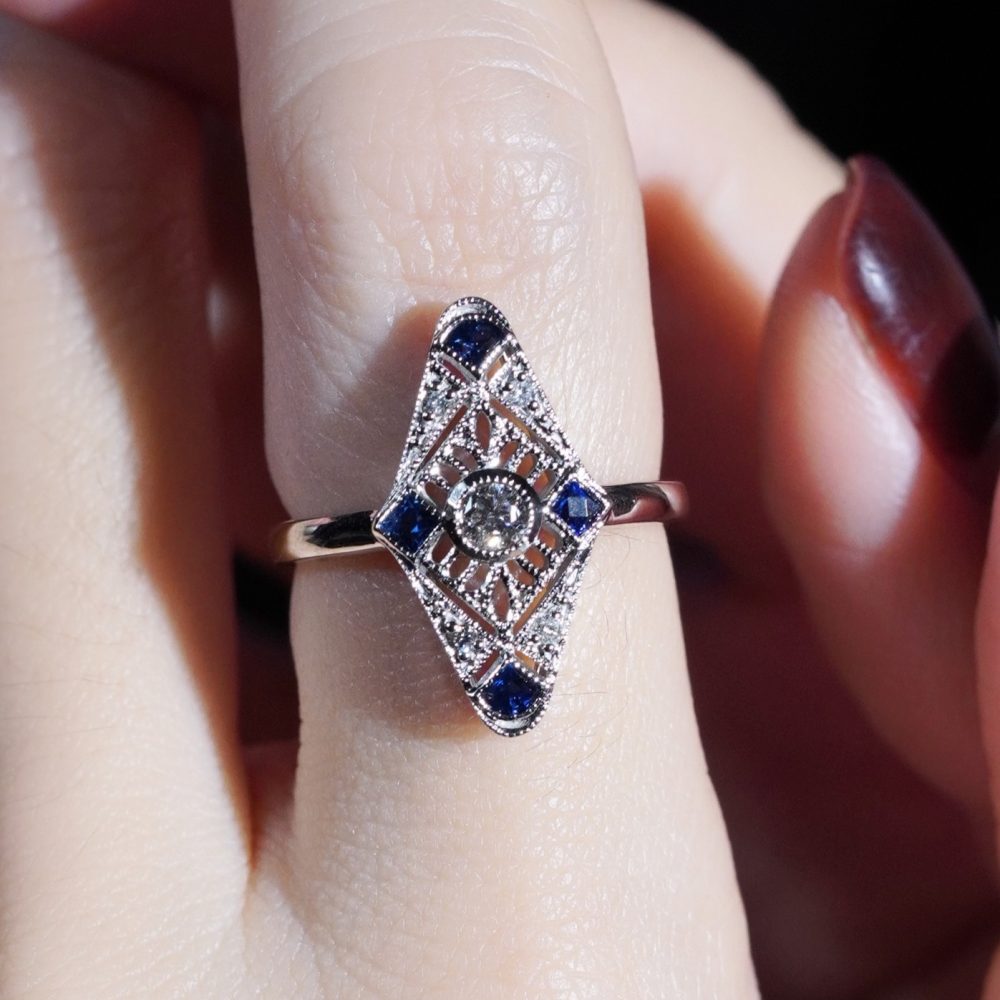
Diamond
Sapphire


Dangle Earrings
Frequently Asked Questions: Art Deco vs Edwardian Jewelry
Which style came first, Edwardian or Art Deco?
Edwardian came first, roughly 1901 to 1915, followed by Art Deco roughly 1920 to 1935. When comparing art deco vs edwardian jewelry by date, there is a short gap between them rather than a direct handoff, partly due to World War I.
What is the single fastest way to tell the styles apart?
Look at the overall shape first: flowing, lace-like curves point to Edwardian, while straight-edged, symmetrical geometry points to Art Deco. Stone cutting is the next most reliable signal.
Does millegrain edging tell the two styles apart?
No. Millegrain, the tiny beaded metal edging, appears in both Edwardian and Art Deco pieces, so it is not a reliable way to distinguish them on its own. The overall shape and motif are better indicators.
Why did both styles use platinum so heavily?
Platinum became workable in jewelry at the start of the 20th century, and its strength let both Edwardian and Art Deco jewelers build finer, more intricate metalwork than gold allowed at comparable thinness — Edwardian used that for lace-like filigree, Art Deco for geometric lattice.
Does Lilly M. make both Edwardian and Art Deco pieces?
Yes. Lilly M. makes new pieces inspired by both styles, in solid gold and platinum. Our jewelry is never represented as a period original or antique — it is new work that draws on historical design.